After sailing through some rather more encompassing areas in the field, it’s time to dive into specifics again. This time around, we’re looking at some of my hot takes on Romance linguistics. Will this turn into a list of gripes? We’ll see!
🔥 Internal classification of the Romance family is incomplete because people have been too lazy to figure it out.
Ooh, a spicy first take! In this house we always love a little background, as a treat, so I think it’s a good idea that this first notion involves much of Romance linguistics itself. I’ll reference Mario Pei’s “A New Methodology for Romance Classification” (1949) because he does a great job both chastising the “haphazard methodology” of his time and foreshadowing what’s essentially the digital humanities, though he thinks of it as simply better linguistics. I’ve studied the Romance languages for years and seen plenty of tries at classifications. Many older ones exclude half of the varieties and today seem to us done on the fly—in part because they were poorly documented or understood, or have been subsumed under national standard languages which may or may not be closely related—while newer attempts sometimes get lost in the weeds with non-representative samples fed into the calculus of consensus trees run amok. Pei critiques linguists who cherry-pick and then make broad claims, ‘postulating a fundamental unity between two or more Romance varieties on the ground of one or two phenomena they display in common’; taking the example of the Old French text La Chanson de Roland, he suggests a lexicologist can use word counts to accurately determine the frequency and origins of words, placing the language “in its proper perspective.” Pei is clearly indicating a precursor to digital humanities in service of discrediting what he considers improper “fantasies” of a “seemingly high number of Germanic loan-words” in the Chanson, using “definite statistics” to disprove overstatements of Germanic influence on Old French. Calling for a more systematic approach by applying what he refers to as the comparative statistical method, the author goes into an example calculation: stressed vowels in Romance. Well done, Mario!1
In Yakov Malkiel’s 1972 chapter from The Study of Languages, he charmingly provides the narrative arc of comparative Romance linguistics, which he says peaked between 1885 and 1915, with Wilhelm Meyer-Lübke setting the standard through works like the Grammatik der romanischen Sprachen (GRS) and Romanisches Etymologisches Wörterbuch (REW). After about 1925, Ramón Menéndez Pidal and Walther von Wartburg enter the intellectual fray and Malkiel mentions that a handful of Romance languages like Sardinian, Dalmatian, Arpitan, and even Mozarabic start receiving serious attention after years in the shadow of their larger relatives Spanish, French, and Italian.2 This was decades ago, and naturally there’ve been years of research since then, including statistical methods, trying to parse out how many Romance languages there are and how they relate to each other. If my hot take seems impatient, it’s merely because (1) it is, and (2) the average person today is still unsure whether English qualifies as a Romance language, let alone knowing about the existence of Sicilian or Occitan, so I feel like we must also lay blame on the expositors of the knowledge the field has acquired.
I’m not a scold, though, I promise! Even if education systems and mass media are clueless on how to cover linguistics, there are people out there doing the hard work of trying to measure this stuff, so let me present one I think is doing a great job. Antonio Sciarretta’s dialectometry on the dialects of Central and Southern Italy is the kind of painstaking work that has given me a much deeper understanding of the linguistic situation on the ground there: with his method, dialects from every town were analyzed based on 18 phonetic traits, grouped into 647 homogeneous areas which were put into a cluster analysis called a k-means algorithm. Measuring the linguistic distance between those varieties, the results suggested eight clusters which, rather than align with traditional groupings based heavily on administrative borders, tended to run along known isoglosses and proved much less arbitrary and more objective.3 See? So it is possible to suss out the languages in a dialect continuum if we keep working at building up the criteria to utilize. I don’t mean that I think it’s cut and dry, and I’m still torn on how to classify languages like Venetan and Aragonese, but the more calculation we come up with, I say, the closer we get to comfortably making a determination. Cugno (2023) may warn you that my head’s in the clouds, as I paraphrase her: ‘The randomness of results from quantitative classifying methods has shown how deceptive the objectivity of numbers can be, while also showing how the subjective choice of features can condition the outcome.’ She indicates Pellegrini’s (1973, 1977) classification of the dialects within Italy as “the model of division that still finds greatest acceptance…which not only studies linguistic features but adds concomitant factors like history, the contact between languages, and linguistic variability, usually according to the modern sociolinguistic perspective.”4
Sciarretta’s research is on phonetic features alone, though morphology and lexicon are also super important. So is syntax. But what about history? Yes, hello, historical linguistics has been my thing, so what is there to say about that? A master’s thesis by Omar Barahona titled The chronology of Romance lenition: The testimony of Gothic loanwords has an interesting approach that I simply *must* highlight if I am to convey what I think language classification should pay attention to in the 21st century: absolute chronology, or precise dating. Barahona ‘explores the linguistic testimony of the Visigothic period in the Iberian peninsula,’ effectively dating the lenition of intervocalic consonants by looking into Germanic loanwords into the Romance varieties of Iberia.5 Plenty of other philologists have looked into dating the transition from Latin to Romance, and my hope is that we’ll continue to make great strides in improving our vision of how the new languages arose.
🔥 The La Spezia-Rimini Line is pointless.
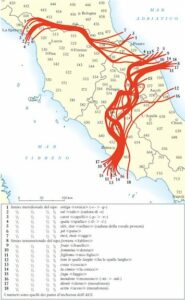
Another provocative claim, I’d say the so-called La Spezia-Rimini Line (also called the Massa-Senigallia Line if we get particular on which towns are at its ends) is kind of pointless for a number of reasons. First of all, what is it? Thanks for asking. It’s a bundle of isoglosses (Remember when I mentioned these a few entries ago? Linguistic boundary lines!) in north-central Italy which, when taken together, appear to separate well-known groupings of language varieties like Tuscan~Italian from the Gallo-Italic~Cisalpine~Northern Italian languages; the varieties on each side are further classed into the much larger Western and Eastern Romance subgroups. The main classificatory distinctions among these isoglosses are the preservation (or not) of intervocalic consonants like /p t k/, the formation of plural nouns and other silly happenings with Latin final -ꜱ, and the dropping of final vowels other than -ᴀ, though other distinctions float around like anterior vs. posterior palatalization of /k/ before front vowels: Lat. ᴄᴇɴᴛᴜᴍ > Piedmontese /sɛŋt/ versus Tuscan /ˈtʃɛn.to/. This last one is honestly a mess in northern Italy, and [this type of] palatalization doesn’t even occur in much of Sardinia, never mind that Balkan Romance doesn’t uniformly behave according to this /ts~tʃ/ division either.
Despite multiple reasons I don’t care for this line, let’s just break down the biggest, shall we? (I’ll talk about Latin final -ꜱ later.) Lenition, or the ‘weakening’ of consonants in certain positions, occurred in much of Romance as Latin evolved into a dialect continuum. This chainlike process usually, but not always, followed a path of degeminating → voicing → becoming a fricative → becoming an approximant before the consonant disappeared. Eastern Romance gets characterized as preserving original stop consonants while Western Romance saw them lenite. The /t/ in Latin *ʀᴏᴛᴀ ‘wheel’ is progressively weaker in each of the following: Rom. roată /ˈro̯a.tə/, Cat. roda /ˈrɔ.ðə/, Fr. roue /ʁu/.6 What about the -ᴛʀ- in *ᴍᴀᴛʀᴇ ‘mother’ and *ᴘᴇᴛʀᴀ ‘stone’? We get Sicilian matri~petra /t/, Castilian madre~piedra /ð/, and French mère~pierre (oops it’s disappeared). But Italian? madre~pietra /d~t/. If you’re getting annoyed by Italian not following the rules we’re trying to establish, join the club. There’s a reason for this and I’ll write more about it later but for now I’ll just mention that more counterexamples to the Line exist, like /p t k/ being maintained in the Pyrenees (aka the West) and degemination in Romanian (the East). Even the fricativizing is shown by /v/ and /ɣ/ across the south of the Italian peninsula, further ruining the applicability of La Spezia-Rimini. Bye, girl 👋.
🔥 Linguicide is no fun: shame on France, Italy, and [until Franco’s death] Spain.
Sorry Fr*nce, sorry Italy, you’re both an embarrassment to the European Charter for Regional or Minority Languages (ECRML) which you’ve signed but still haven’t ratified. I don’t even have much else to say here. Shame on governments with monolingual ideologies that they push on their people. Do better.
(Actually, shame on all of the countries that haven’t done more to protect their own indigenous languages. Other non-ratifiers in the Romance realm include Portugal, Belgium, and San Marino, and a big “Booo” to the colonial and post-colonial governments in the Americas and around the world also pushing largely monolingual agendas, including for a Romance language.)
And by the way: linguists haven’t been great about this either. Even Meyer-Lübke granted “[legitimate] status to Sardinian and to newly discovered Dalmatian, while trying to withhold comparable recognition from Catalan, from Franco-Provençal, and from North Italian,” as Malkiel wrote, continuing that there have “appeared countless books — often half-baked or fragmentary doctoral dissertations — which were comparative in approach but advisedly modest in the range of languages selected for joint assessment. Typical monographs of this kind either explicitly identify the three or four languages included in the author’s purview…the results of this type of skewed or one-sided analysis have, in part, been deleterious, because of the implied threat to the all-important balance of documentation.”7 An article by Ryan (2018), “Embracing Neapolitan as a Language Which Is Key to the Reconstruction of Early Romance,” is a good example of how, by focusing on national languages to the neglect of other Romance varieties, linguistic research is lower in quality than it would be with greater inclusivity.
🔥 Romance nouns: they [nearly] all come from the accusative case!
We’re getting back to Latin final -ꜱ now; I’ll focus on plural nouns but verb forms are worth noting, too. The simplistic explanation goes that Western Romance maintains ‘sigmatic’ (-ꜱ) plurals based on Latin’s accusative case (–ĀS, -ŌS), while Eastern Romance (understood as Italo-Romance plus Balkan Romance) kept instead the nominative forms (-AE, -Ī). Let’s use the examples ‘roses’ and ‘books’: Lat. *ʀᴏꜱᴀꜱ > Pt. rosas, *ʀᴏꜱᴀᴇ > It. rose; *ʟɪʙʀᴏꜱ > Sp. libros, *ʟɪʙʀɪ > It. libri.8 Plain and simple, right? Well… I withheld from you that -ĒS (and -A) occur in both the nominative and accusative plural cases: ‘dogs’ is Latin *ᴄᴀɴᴇꜱ > both Occ. cans and Rom. câini. So what the hell? “Analogy!” some may shout. But what about ‘friends’ (f.): *ᴀᴍɪᴄᴀꜱ > Pt. amigas, okay, but *ᴀᴍɪᴄᴀᴇ ⩼ It. amiche /aˈmi.ke/ yet also Rom. amice /aˈmi.tʃe/? Make it make sense. This morphological confusion made obvious by the presence or absence of palatalization feeds into what people call the accusative theory, though the term is a little misleading and some have taken what I’d call “real” and “fake” versions of such a stance. You see, dear reader, by looking at this inconsistent palatalization and other matters, like Old Latin’s nominative feminine plural ending -ĀS not matching Classical Latin’s -AE (…lazily dropping a relevant Wiki article here, ugh I’m sorry we don’t have time), Romance linguists have been coming around to the conclusion of an early Romance -ĀS for both the nominative and accusative feminine plural cases. It’s further proved by Old French’s two-case noun system. Merely arguing that the nominative was identical to the accusative for feminine plurals only, but that masculine and neuter plurals continue to derive from nominative -Ī and -A, is what I’d call the “fake” or lazy version of a theory we’re somehow calling the ‘accusative theory’ yet backtracking in its explanation. I’m not yet advanced enough in this debate to try to refute it and I’d rather it had a more accurate name; it may well be the closest to reality and is certainly better than the La-Spezia-Rimini-inspired “nominative for the whole East!” claim. The examples running counter to our dear Line are also in the verbal systems of Italy, with instances of Latin -ꜱ living on to the south and inconsistently remaining to the north. Benincà et al. (2016) cover the northern side of this well in The Oxford Guide to the Romance Languages, and some fascinating research they mention is a comparative study by Forner (2005) of Alpine Ligurian dialects pointing at accusative -ŌS taking the path > [uj] > [i], factoring out the need for the nominative altogether!9 This is what I’d call the “real” accusative theory; with some trepidation, I’ll admit I’m rather persuaded. As a parting gift, check out this Reddit thread that doesn’t suck if you’re interested in exploring that morphological possibility further. It features a response from Raphael Turrigiano, who I mentioned in my twelfth blog on popular linguistics online.
🔥 “Chaque mot a son histoire” is [at least sometimes] right.
My tenth blog, “The Evolution of Historical Linguistics and its Computational Turn,” touched on the nineteenth-century debate between the Neogrammarians’ hypothesis that sound change in languages is consistent and exceptionless, and the belief shared by Schuchardt and Gilliéron that instead, chaque mot a son histoire (“each word has its own history”). In defending this latest spicy claim, I’ll immediately equivocate slightly by saying that I do believe in regular sound change the majority of the time, but just as we contain multitudes, languages will always demonstrate exceptions to the rules; this variety, this dialect leveling~blending, can make some things unknowable to us. Sure, I bet that sometimes a phoneme will shift in a more or less uniform manner, gradually, but in plenty of cases it’s a matter of lexical diffusion, meaning that the change occurs word by word. This is actually why modern English words spelled with ⟨-oo-⟩ can be found in three different lexical sets, pronounced /uː/, /ʊ/, or /ʌ/, even varying by speaker: how do you pronounce roof, for instance?
The Romance example I’d love to share is higlighted in an article by Joel Rini (1993) titled “On the evolution of Spanish cigüeña and the blending of multiple variants.” The Castilian~Spanish word cigüeña /θiˈɣwe.ɲa/, /si-/ ‘stork’ descends from Latin ᴄɪᴄᴏɴɪᴀ, which we’d normally safely presume to have a long O and the other vowels short: /kiˈkoː.ni.a/. Rini goes through the expected phonological evolution of each aspect of the word: perplexingly, “every other rule of historical phonology appears to have been broken” aside from the letter C both in initial and medial position. Before a front vowel, Latin /k/ palatalized to /ts/ in Old Spanish, while intervocalically it lenited to /g/; today these sounds are variously [θ~s] and [ɣ~ɣ̞], respectively. Then there’s the short I, which’d normally lower to /e/ in most environments, yet here it’s still /i/.10 Long O should stay /o/, but here it’s behaving as a short O and diphthongizing to /we/. And then Rini provides us with the three possible results of the ending -ᴏɴɪᴀ after becoming /ˈo.nja/: (1) the yod /j/ could palatalize the N to become -oña /ˈo.ɲa/, (2) the O could raise to /u/ before the former processed occurred, so -uña /ˈu.ɲa/, or (3) the yod could’ve even metathesized (jumped into the preceding syllable) without palatalizing the N, so -oina /ˈoj.na/. This means we’d expect *cegoña, *ceguña, or *cegoina, yet here we are with cigüeña! To make a long story short (but it’s worth reading the full article), the only explanation possible is that the blending of multiple variants occurred, as no single one could produce such a result. The textual evidence appears to support Rini’s point.11 Another bird name without a straightforward history is ostrich, which originates in Ancient Greek στρουθός (strouthós) but came through a derived form into Latin as *ꜱᴛʀᴜᴛʜɪᴏ, -ᴏɴᴇ. The Romance language results range from normal semi-learned derivations like Italian struzzo and Old Occitan estrutz to the French form autruche showing the prefixing of avis ‘bird’ > *au- > Old French ostruce, entering into English to later become ostrich; this is also the origin story for the word osprey, meaning ‘bird of prey.’ More or less the same occurred when the Old Occitan form for ostrich was borrowed into the languages of Iberia which likewise prefixed it with ave- ‘bird’ to give Pt., Gal., Cas. avestruz. Yay birds!
🔥 The term “Gallo-Romance” is problematic because misunderstood and inconsistently extended.
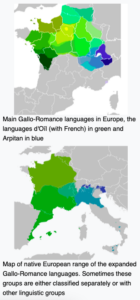
So, I’m with the mainstream view of Gaul being a place → Gaulish being an ancient Celtic language → a significant Celtic substrate influencing the development of Romance where the two cohabitated. No argument there. What I see as tricky, however, is the extent to which we can~should apply the label Gallo-Romance as we continue to tease out how to classify Romance varieties. My assessment is that we can experiment all day with ways of looking at the data as objectively as possible to determine languages and dialects and how to classify them, but in the end the name we give a particular lect is always a subjective choice—one we may try to make with a grassroots spirit, but which isn’t guaranteed not to provoke fierce opposition. Take Arpitan, for example, which has traditionally been called Franco-Provençal when not simply belittled as patois: no one name has risen through the ranks for easy, widespread use, though I prefer Arpitan for its singularity and common online use in the modern age by people who recognize its rightful status as a language. Anyway, if we use the term Gallo-Romance strictō sēnsū as in the upper map here, it would seem to risk ignoring the genealogical commonality of a group extending as far away as Valencian to the south and Friulian to the east. On the other hand, the differences between the languages under this large tent are significant, and it’d be more helpful to lean on subgroupings like a northern core group of Oïl varieties plus Arpitan, a larger Occitano-Romance to the south, and another out east for the Cisalpine realm covering the varieties of northern Italy and southern Switzerland. I’ve seen the first two called Northern and Southern Gallo-Romance respectively, though the third grouping gets a variety of labels like Gallo-Italic, Gallo-Italian, Northern Italian, Rhaeto-Cisalpine, and more.
As regards Catalano-Valencian and Occitan, I defer to my esteemed colleague Jordi Cassany-Bates’s doctoral thesis, El valencià o català, llengua dins del diasistema occitanoromànic: Fonamentació i revisió (2020), in which he lays out how Catalano-Valencian is a variety of an Occitano-Romance diasystem, became an Ausbau language, and has become increasingly distanced from the other varieties in the family (those which we’d call simply the Occitan language). He also synthesizes what several authors have stated about if we were to imagine all possible hierarchical levels between Catalano-Valencian and a much older and higher-level Gallo-Romance: Catalano-Valencian would first group with Gascon and/or the Lenguadocian dialects of Occitan, then ‘form with the rest of Occitan the Occitano-Romance group, which would itself be a (southern) branch of Gallo-Romance together with the northern branch (Oïl and Francoprovençal) and the eastern branch (the Romance varieties of Cisalpine Gaul and Rhaeto-Romance).’12 For how to untangle the Gallo-Italic branch, I look not only to Benincà et al. (2016) and Tamburelli and Brasca (2017) but also several young linguists relatively early in their careers whom I’ve found through various online communities. And many of us are certainly indebted to Geoffrey Hull’s 1982 doctoral thesis, The linguistic unity of Northern Italy and Rhaetia: Historical grammar of the Padanian language.
🔥 Standard Italian is a zonal auxlang for a language family that doesn’t exist.
My final hot take is that Italian is an auxlang. Actually, so is German, and so is Rumantsch Grischun, the standardized version of Switzerland’s fourth language, Romansh. What does this mean, and is it a dig against these languages or what?
My last blog identified auxiliary languages as those designed to facilitate communication between speakers of different languages. Linguifex‘s definition is “a conlang which is designed primarily to function as a lingua-franca or means of communication between different people(s) who speak otherwise incompatible languages,” while the Wikipedia article on them currently states auxlangs are those “meant for communication between people from all different nations, who do not share a common first language. An auxiliary language is primarily a foreign language and often a constructed language.” This practice is by no means only for the chronically online; on the contrary, it goes back to the 1800s with Volapük, continuing through the years with Esperanto and Interlingua and today with countless zonal auxiliary language (ZAL) projects like Interslavic, several attempts at an inter-Germanic or inter-Finno-Ugric language, and so on. My point about Standard Italian or Standard German, then, is how fuzzy this gets when you compare the work of the hobbyists with that of the lobbyists. It feels to me that the meaning of ‘conlang’ is now divorced from the literal meaning of ‘constructed language’ and that while the former definition is now steeped in sci-fi and fantasy fandoms, the latter remains an accurate description of what language standardization often entails. Why do we criticize attempts at a standard Ladin Dolomitan or a unified Sardinian while drooling over Dante’s vernacular writings or the Standard German influenced by Martin Luther’s Upper Saxon?
To keep focused on Italian, we can look to the inconsistencies of its standard form as evidence that it has truly been made up. You already know my thoughts on the La Spezia-Rimini Line, but let’s consider some Latin words with intervocalic voiceless stops: keeping in mind that Standard Italian is mostly based on the medieval Tuscan variety of Florence, it’s no surprise that the reflexes of Lat. *ꜱᴀᴘᴇʀᴇ, *ʀᴏᴛᴀ, *ᴀᴍɪᴄᴀ preserve the same sound in modern It. sapere, ruota, amica. But then when we look at Lat. *ᴘᴀᴜᴘᴇʀᴇ, *ᴘᴀᴛᴇʟʟᴀ, *ʟᴀᴄᴜ, we find modern It. povero, padella, lago with clear lenition… or even mixed forms like *ꜰɪᴄᴀᴛᴜ > fegato. Why? Ledgeway offers in the Oxford Guide to the Romance Languages (2016) that many of these words came from Tuscan dialects along the periphery, ones which do show voicing of Latin /p t k/—Wiktionary has a great list of these words. I want to point out that dialectal admixture itself is not a problem, but its consequences for the collision of modern Romance linguistics (and the contrasts it draws) with the relatively recent literacy of the Italian people are, to put it lightly, annoying. You have no idea how often Italian words or historical sound changes get labeled “from French!” when really, how often is that true? Florence is less than 100 km from the La Spezia-Rimini line. Dante had an incomplete picture of Romance dialectology when he got the ball rolling on an Italo-Romance standard. Sure, the Florentines paid attention to cities like Milan or Genoa to the north, but frequently these lexical items or phonological changes like lenition are simplistically implied to be the result of some deference to Paris when they’d be better explained as already existing in the neighborhood, no? Ledgeway would agree: “indeed, in a number of cases the lexemes affected are only found in the literary (standard) language but are not indigenous to Tuscany…In most cases, however, external influence looks at best highly doubtful, since many of the words affected involve lexemes showing voicing in all (Italo‐) Romance varieties, hence probably already voiced in common spoken Latin.”13
Everyday people’s reactions to their language being standardized and the perceived artificiality of a standard are an important part of what I’d like to explore further this semester. More than just the linguistic anthropology of it all, I wonder which specific, linguistic aspects of standardization might be the ones triggering the most or least angst among dialectal speakers. Or conversely, is it even a linguistic matter at all, or is it the more overarching feeling of being included in the process? This should tie into my next post.
- Pei, M. A. (1949). A New Methodology for Romance Classification. WORD, 5(2), 135–146. https://doi.org/10.1080/00437956.1949.11659494 ↩︎
- Malkiel, Y. (1972). Comparative Romance linguistics. The Study of Languages, 9, 835–926. https://doi.org/10.1515/9783111684970-003 ↩︎
- Sciarretta, A. (2024). Dialectometry-based classification of the Central–Southern Italian dialects. Journal of Linguistic Geography, 1–11. https://doi.org/10.1017/jlg.2024.7 ↩︎
- Cugno, F. (2023). Italian dialect classifications. Dialectologia, 2022(10), 197–230. https://doi.org/10.1344/dialectologia2022.2022.8 ↩︎
- Barahona Barahona, O. (2015). The chronology of Romance lenition: The testimony of Gothic loanwords [Master’s Thesis]. https://studenttheses.universiteitleiden.nl/access/item:2625111/view ↩︎
- When we put an asterisk before a word, it may be reconstructed or unattested. Many use terms like Vulgar Latin or Proto-Romance as opposed to (Classical) Latin to label these words. I’m going to keep things straightforward and call the words Latin and assume the accusative case, but especially since I’m not including the final -ᴍ this case would’ve had in the Classical era (acc. ᴍᴀᴛʀᴇᴍ, ᴘᴇᴛʀᴀᴍ), I’ll use an asterisk and try to keep our focus on the consonantal change. ↩︎
- See footnote 2. ↩︎
- I haven’t shown short/long vowel distinction because of word processing issues. For those with years of experience in writing articles with Latin vocabulary, how do you manage to type a macron (¯) on top of small caps? Unicode doesn’t offer it and the combined character has a skewed-to-the-right macron I dare not show. ↩︎
- Benincà, P., Parry, M., & Pescarini, D. (2016). The dialects of northern Italy. The Oxford guide to the Romance languages, 185-205. ↩︎
- On a slight tangent, I am somewhere between agnostic and in disagreement with the existence of lax vowels in Latin, so I’m inclined to believe that short I was /i/ before it became /e/. ↩︎
- Rini, J. (1993). On the evolution of Spanish cigüeña and the blending of multiple variants. Hispanic Review, 61(4), 519–529. https://doi.org/10.2307/474263 ↩︎
- Cassany-Bates, J. (2020). El valencià o català, llengua dins del diasistema occitanoromànic: Fonamentació i revisió [Doctoral Thesis]. https://dialnet.unirioja.es/servlet/tesis?codigo=292922 ↩︎
- Ledgeway, A. (2016). Italian, Tuscan, and Corsican. The Oxford guide to the Romance languages, 211-212 ↩︎