
Using Loyola’s University Archives and Special Collections, I chose to create and then analyze a corpus made up of six documents spanning the years 1857–1892 and offering insight into early Chicago history:
At first I wanted my manner of exploration to aim towards proper nouns: people, places, and other entities, but with particular emphasis on locations. We’re an average of 150 years removed from these texts, and I wanted to see if we could identify certain standout names: streets, bodies of water, and perhaps places outside of Chicago that might’ve tended to receive mention during our city’s formative years. Something I’d still love to suss out, but which doesn’t yet seem possible on a larger scale, would be how to separate certain proper nouns which coincide with common nouns; South Water Street has a specific location in the city, yet is made up of words that would normally become stopwords if I were to impose limits on the corpus. None of the tools I browsed had the ability to distinguish capitalized versus uncapitalized words, but then again my expectations may be a little high here. Case in point for some of the transcription I was working with:

No better water cat! be f.niiid than that with which our City is eoii.<taiit]y Mii)plie(i.
It is taken from Lake Mielujian, at the foot of Chicago Avenue.
Ahh yes, those sweet, sweet waters of our beloved Lake… Mielujian. I prepared the texts for analysis as best I could, initially putting in the PDF versions hoping in vain that Voyant would ignore the already-embedded transcribed text and would scan with a superior-grade technology I’d pretend that it had, but… hey, we’re here to learn and experiment, not produce groundbreaking work on the first try. The many, many words hyphenated across line breaks weren’t picked up, either, explaining why ing and tion appear among the top-occurring “words.”
Upon the corpus’s loading, the first and most visually arresting Voyant tool is without a doubt the Cirrus word cloud. Here are the straightforward results when the most common English words are removed:
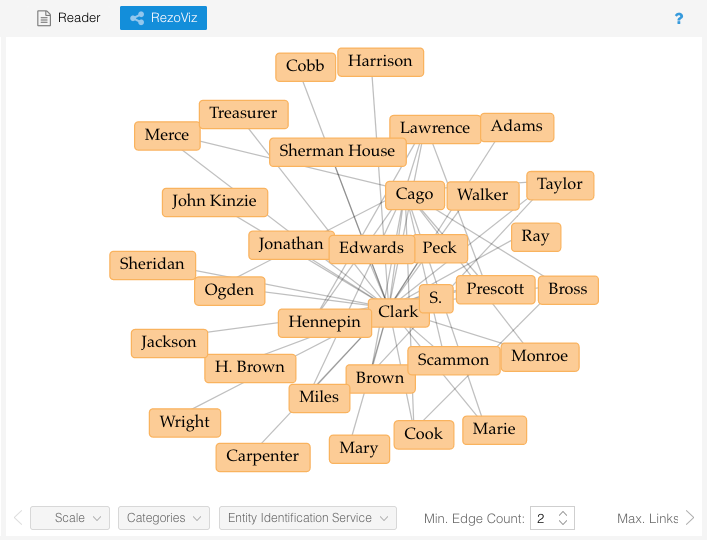
In addition to the above words speaking to a rapidly-expanding city—street, building, business—the results also included other words one might expect from this era: iron. steam. steel. trains. I had occasional suspicions about a word being part of a name, such as van or la or even st (Van Buren and LaSalle are debatably one word or two separate, and many instances of St. could be Saint, as in Saint Paul, MN, or as part of a church’s name), but regardless it was interesting once I started digging into the list and thinking… how might I identify and explore those proper nouns I so desperately sought from the corpus? In my review blog of Coptic SCRIPTORIUM, I mentioned how excitedly they brandished their entity recognition tool, so I tried to join in on the fun and use RezoViz for its purported entity recognition capability. Voyant’s own help guide states in RezoViz’s listing: “Please note: this tool is one of the least reliable ones in Voyant (especially with larger corpora), in part because the processing of entities requires more time and computation than most other operations.” Also, two of my six documents were declared too large to include. Really reassuring stuff, creators, thanks!
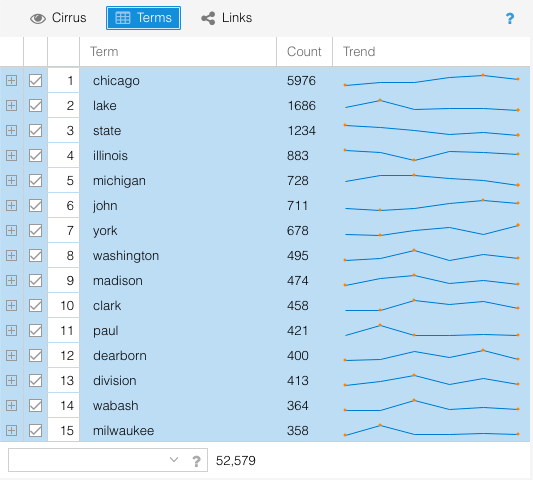
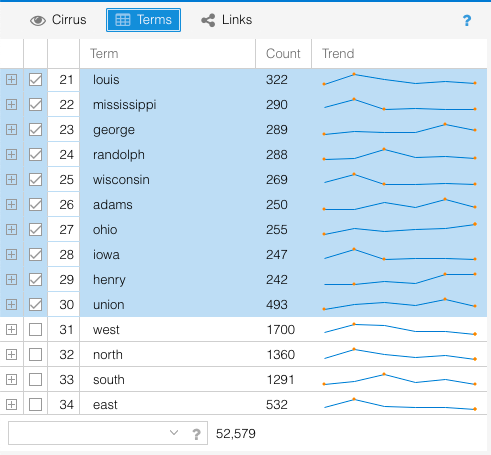
I decided to go rogue and whittle down the Cirrus list by adding word after word to the English list of stopwords, but as that grew tiresome I switched to simply checking the boxes to highlight words I deemed proper nouns. I cheated a bit, allowing known placenames like Lake [Street] or Union [Station], and of course we could dig in further to prove how many of the Chicago occurrences were just picked up in the title of the publication at the top of each page. Still, another neat finding you’ll note in the right-hand image below is that I kept the four cardinal directions out of the stopwords list because they demonstrate a few things which I’ll hypothesize here: west will be the top choice because two of the sources label Chicago as a marvelous “City of the West”(!), while east occurs significantly less frequently, in part because we have water where an “east side” of the city would be if we were surrounded by land on all sides instead of at the confluence of rivers and a Great Lake.
Though I didn’t immediately find what I wanted to, I learned quite a bit as I manipulated the various tools and ended up getting pretty close, essentially reaching my goal through some extra brute force. TermsBerry has its neat scale for collocate frequency and Contexts shows each occurrence of a word within, well, its context. Even the summary tool, which I thought might be kind of unremarkable, piqued my interest a bit with its distinctive words (like surgery in my sixth source).
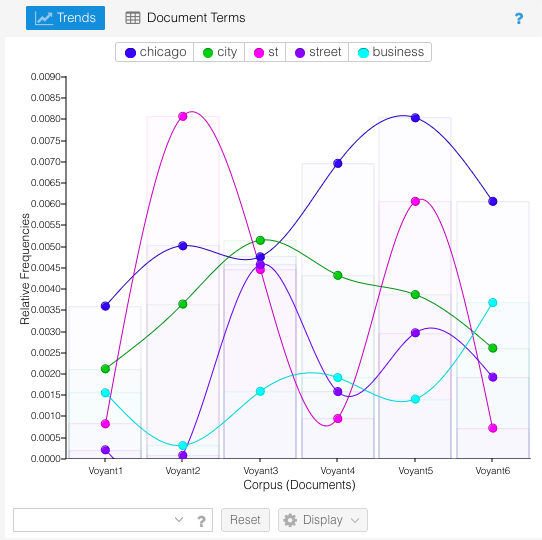
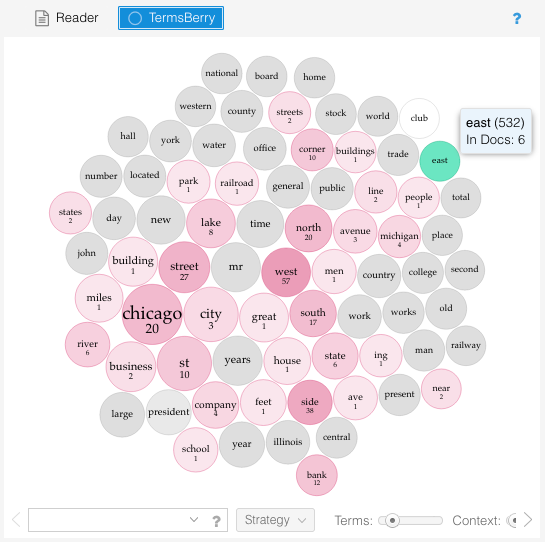
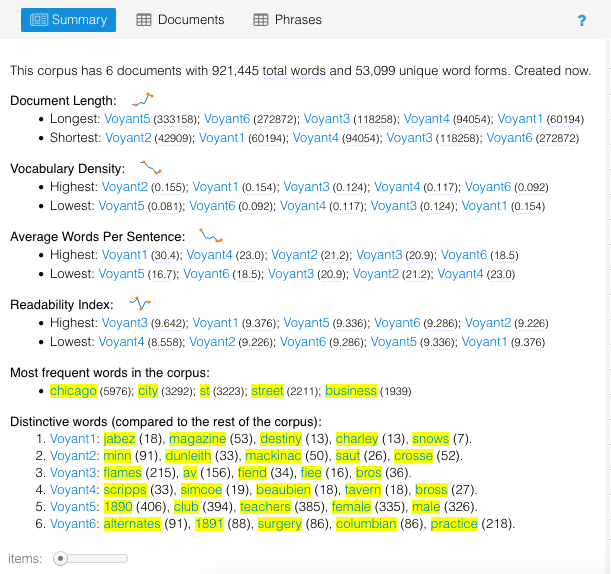
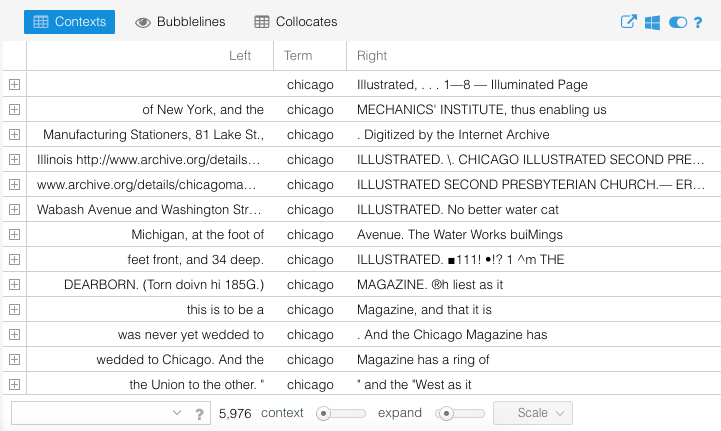
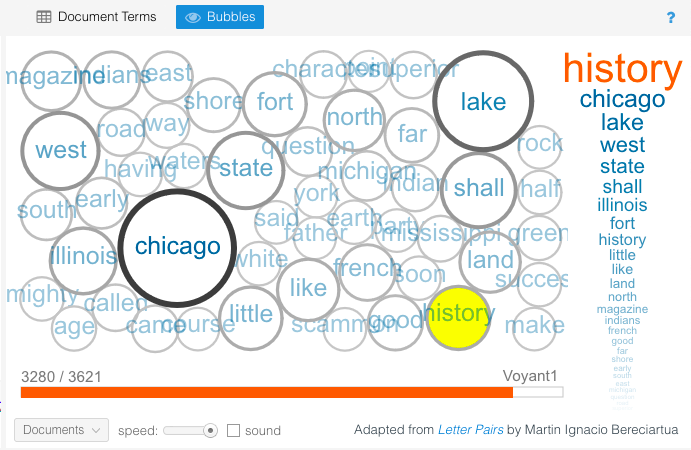
One final example I’ll give was Bubbles, which was a novel one to watch in that it shows the ranked cumulative word frequencies of a document in a time-lapse sort of fashion. For my 1857 source, I watched as the word French took an early lead and then shrunk with the passing of time, just as the early French presence in Chicago did… quel dommage!
I really enjoyed reading the blog, the pun on the title is so witty! I really liked the fact that you have shared your texts, and also snippets of the transcription. You weave humour so well along with data which made for some fantastic reading. Your explanation on how you used the tools made it easier for me to understand your perspective.
I think your post is great, Tim. The Bubble skin is pretty cool — I didn’t explore this with my document sets so I’m glad you presented it here. I find your narrative of your exploration of Voyant to be both interesting and entertaining — the discovery of patterns of language is always surprising in certain ways and I enjoyed your reflection on that process. I also want to respond to your comment on my post because you too include the Summary skin here. I agree that in the vein of display that Voyant does so well the Summary skin is rather “unremarkable,” but I think where you and I have both landed is, in understanding this skin in an indexical sense, it can be the basis for much progressive thought and investigation moving forward.
This great, Tim. You write both about your process and your findings, which is exactly what you should do. I’m struck by the limits you found to some of Voyant’s tools. I’d not seen that documentation before. Great work.
I always look forward to reading your posts partly because of how deftly you embed humor and your unconventional interpretation of the topic. I am glad I am not the only one who enjoy talking about Chicago! I share in your pain of limiting common/grammatical words, particularly because some may be relevant in some context while largely irrelevant as a whole. The results of the distinctive words in the summary tool surprised me a bit because I am fairly new to Chicago and expected to find some words which I did not see. I also liked the context tool but could not interpret the data as I desired. A very exciting project overall!