
For a while I’ve had an idea for a blog on how world events connect with and often end up accelerating~sharpening the information available online, and especially how crowdsourcing factors into this. When we think of geopolitics + internet + protest movements, we may think firstly of episodes from the 2010s like Twitter’s use during the Arab Spring or Facebook check-ins at Standing Rock in solidarity with protests against the Dakota Access Pipeline, but I have something nerdier and more granular in mind. Wikis offer us the ability to track, down to the minute, each edit to an article about any given topic, and this is what fascinates me about the interplay between history as it occurs and the historical archiving we’re able to see afterwards but don’t notice during, happening in the background as events unfold. The history of the internet is interesting in its own right, but I wanted to explore the people-powered side of the web and how it chronicled a handful of world events in particular: Russia’s invasion of Ukraine, the presidential campaign(s) of Kamala Harris, the arrest of Luigi Mangione, and the election of Pope Leo XIV.
We could say that crowdsourced platforms react to historymaking in real time… though these days it’s beginning to feel less like “the internet is reacting” and more like we’re watching history be produced as much as it’s processed online. I will not be writing about prediction markets and political elites nor the rampant insider trading going on in the early part of this year, but those’re certainly relevant. Instead, I’ll be looking especially at two sites where I spend a statistically significant amount of time: firstly, Wiktionary.org. I do lots of research on a variety of linguistics topics and teach ESL by day, and I refuse to treat etymology and pronunciation (both of which feature prominently at the start of a typical Wiktionary entry) as optional side notes. I’ll also be looking into its big sister Wikipedia.org, which I’ve watched go from janky to swanky over the past quarter-century.1 While I agreed with my high school teachers c. 2000s that Wikipedia wasn’t a valid source to cite in a paper, I am now a teacher c. 2020s and was recently back in school for a master’s, and I now find wikis a useful enough research tool in the sense of being increasingly respectable vehicles toward further sources. Last year I watched a former president of Wikimedia Australia speak at a conference I attended, and although that wasn’t the singular moment of shift for me, it helped my thoughts on the matter solidify: I don’t hate on Wikipedia anymore, even in academic contexts… though personally, I’m still unsure I’d recommend someone cite it directly in an academically published work. As you’ll see here today, it’s literally the topic(!), so I am citing plenty of Wiki examples.
Not everything in the wikiverse goes smoothly, of course. There are edit wars, vandalism, reversions, and bursts of activity that come and go in waves, all of which are now studied in a pretty formal way by some lovely people. I think around features like identity and legitimacy (both of which certainly touch language itself) it’s safe to expect that some areas are never fully settled. My point here is simply that for many articles at least, it’s cool to see a compressed record of disagreement, consensus, and correction going into the final product.2 And as for the users who edit and moderate wikis, they aren’t all nerds or keyboard warriors or spooky Anonymous types, either. When was the last time you peeked behind a Wikipedia article to look at its Talk section, if ever? That can be its own form of entertainment, and I like being able to view how people have reached consensus behind the scenes.
Our first case is how the internet populace has handled Russia’s war against Ukraine. As we know well, Wikipedia entries can end up acting as proxy battlegrounds. It’s more complex than simply Russians versus Ukrainians, however. Anti-Kremlin Wikipedians (both Russian and non-Russian) have sought to continue editing anonymously while Putin’s administration has cracked down on them, making arrests and threatening to ban the site. Would you believe there’s even a Wikipedia article about Wikipedia in the Russo-Ukrainian war?
Sticking to the matter at hand, I wanted to take a look where we could spot metrics which show how the war has affected editing activity on relevant Wikipedia articles. Starting with Ukraine’s entry, look below at two different representations of page activity: the first graph shows page views, while the second shows edit activity (both the number of edits shown by the colored bars and then the overall article size shown by the orange line). In both cases, the February 2022 invasion corresponds to some big changes, but maybe not in the most obvious way.
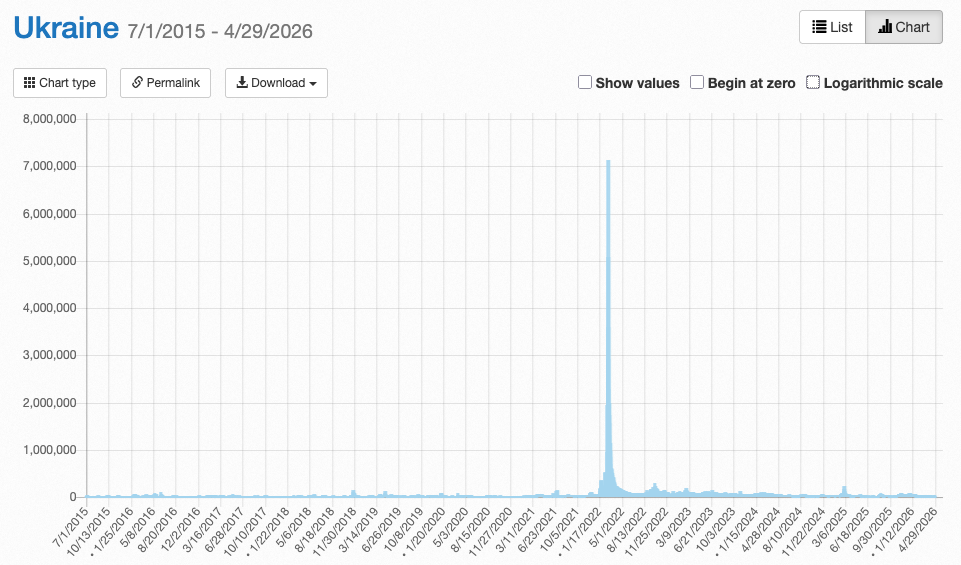
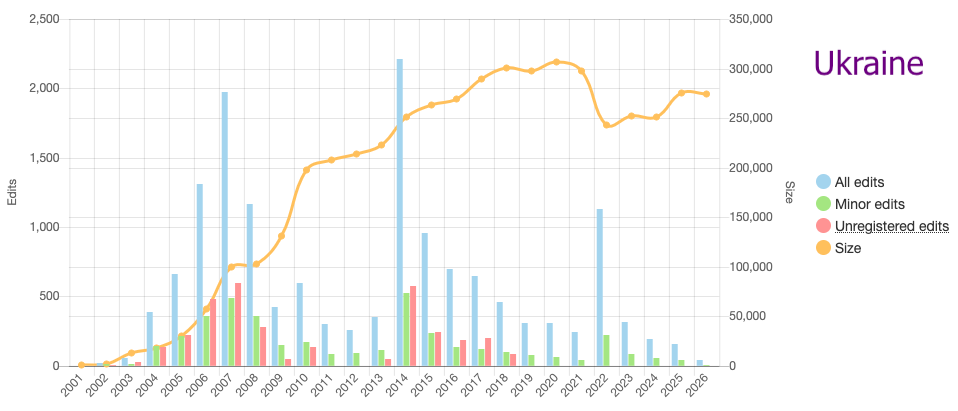
As we see, millions of people checked out Ukraine’s entry in February 2022. I must point out that the source data for page views can only go back as far as July 1, 2015, which is after the 2014 start to conflicts between Russia and Ukraine. Perhaps we’d see a similar spike in 2014 and before then we’d see a lower floor for page views. But beyond that, looking at the second graph, we see a spike in edits in 2022, yet the page size actually fell. Why? My interpretation is that the Russo-Ukrainian war, which had already begun in 2014 with the invasions of Crimea and Donbas, was now so hefty a topic that it needed to be excised from the main Ukraine article and given an entry of its own. As one user phrased it in their edit description on February 25, 2022, “(→Russian 2022 invasion of Ukraine: Article about Ukraine, not U.S. foreign policy/sanctions).” So it’s interesting to spot an organic example of an article’s size rising and falling as moderators ensure it doesn’t enter into “Too much detail” or “Out of scope” territory.
Take a look below and next you’ll see a side-by-side for the Dnieper River’s Wikipedia entry: again, the first graph shows views while the second shows edit activity. Kind of interesting that bumps in total edit activity (the blue bars in the second graph) seem to correspond to the 2014 and 2022 escalations of the conflict, with another in 2020. Going from 2022 into 2023, the page increased in size while the number of edits decreased, leading me to believe that the edits that year were ‘chunkier’ (more bytes per individual edit).
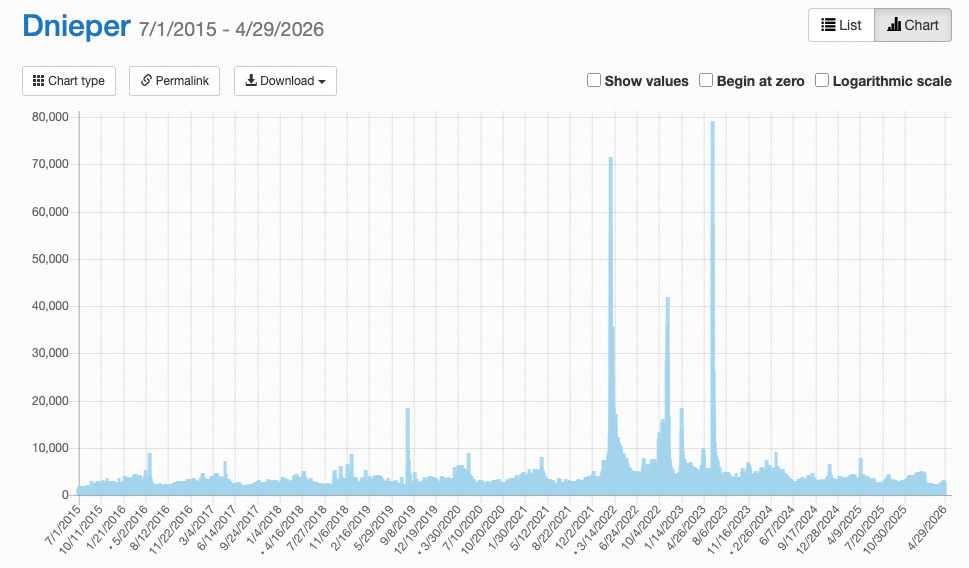
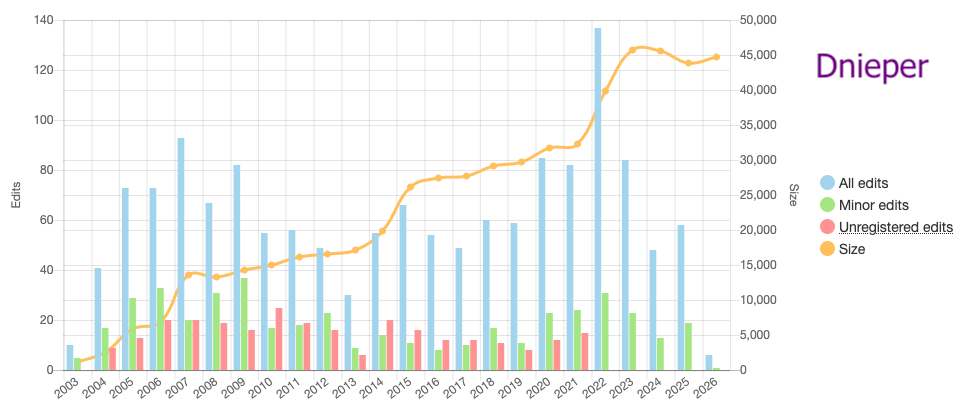
Meanwhile in the first graph, we see that the first of the three biggest spikes in page views occurs in February 2022 with the invasion, with another spike in November 2022 corresponding to the Dnieper campaign‘s culmination in the liberation of Kherson, a major city on the river. The biggest spike of all comes in June 2023, with the destruction of the Kakhovka Dam. You could pick other placenames (Bucha, Donetsk, etc.) or any one of various events during the conflict, and these analyses are replicable on my beloved Wiktionary or on Wikipedia.
There’s plenty that can be said about Kamala Harris’s two failed runs for POTUS, but that’s not within the scope of this blog post; I simply wanted to share some of my findings from Wiktionary. We can see quantitative evidence that the increased attention paid to her political campaigns positively correlates to the increased number of edits (and relative size) of these two entries related to her name: Kamala (below, at left) and कमल (Sanskrit kamala, “lotus”; below right).
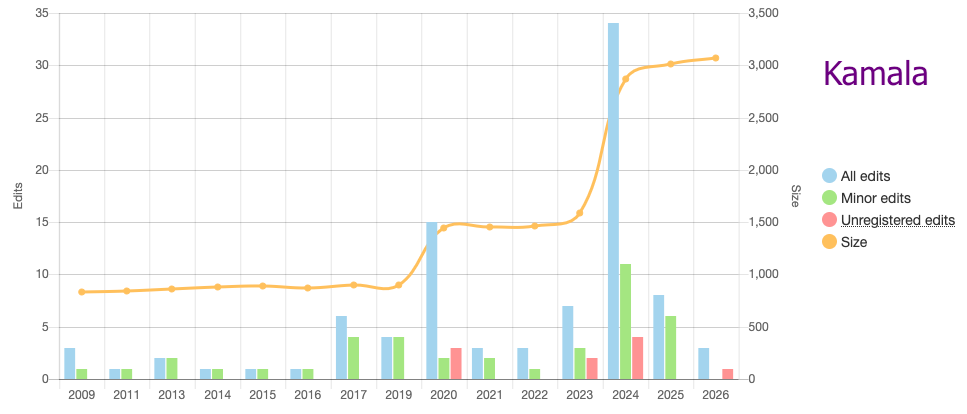
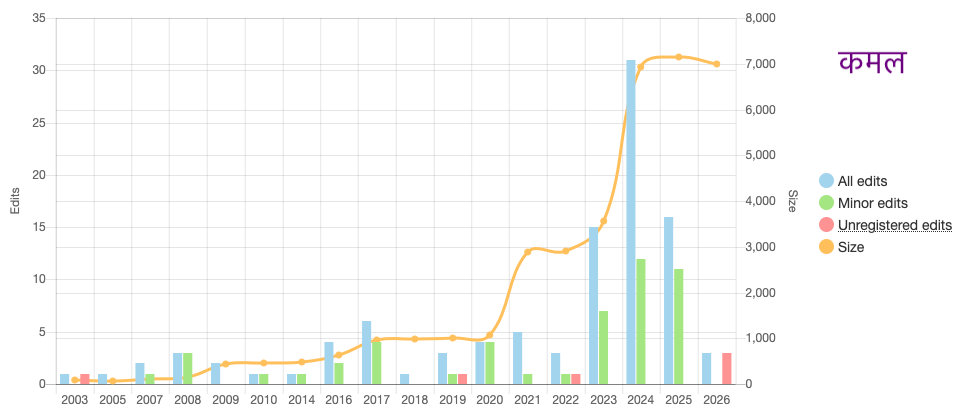
The first spike in page edits to the entry for the given name Kamala occurs in 2017, the year Harris was sworn in as a US Senator, though the size of the article remains stable. The year 2019 shows no bump, which is interesting (or sad?) given that Harris’s first presidential campaign lasted from January–December of that year; it is rather in 2020 that we first see a bump as Harris was named running mate by nominee and eventual winner Joe Biden. Things remain stable until a major uptick in 2024, the roller-coaster political year in which all eyes turned to VP Harris as she was passed the baton and tried to make a sprint for the office of next President of the United States. Likewise, with कमल we see it has two major increases in page size occurring in 2021 and 2024, though the amount of editing activity was in fact stable in 2021. Neat!
For a taste of how much Wiktionary has developed through the years, take a look at the below before/after of the Hindi (not Sanskrit) entry for कमल from its creation in 2003 to present-day 2026. We see the Etymology and Thesaurus templates are empty at first, but these days plenty of other facets of the word are featured in the entry, like its pronunciation and declension and even a link to the corresponding Wikipedia article.
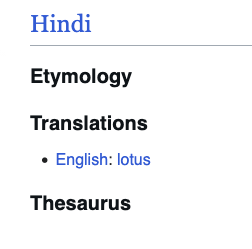
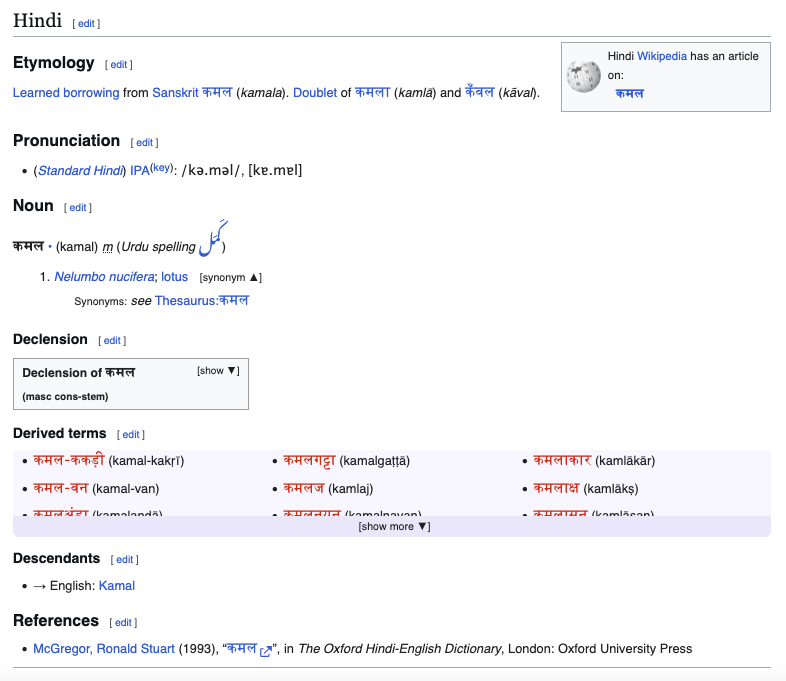
In December 2024 when Luigi Mangione was arrested and charged for the killing of UnitedHealthcare’s CEO, the internet lost their damned minds. Not only was the babygirlification of Mangione an absolute trip to experience, but the online reaction got institutional researchers formally looking into the cultural phenomenon, even questioning, is this… digital populism?
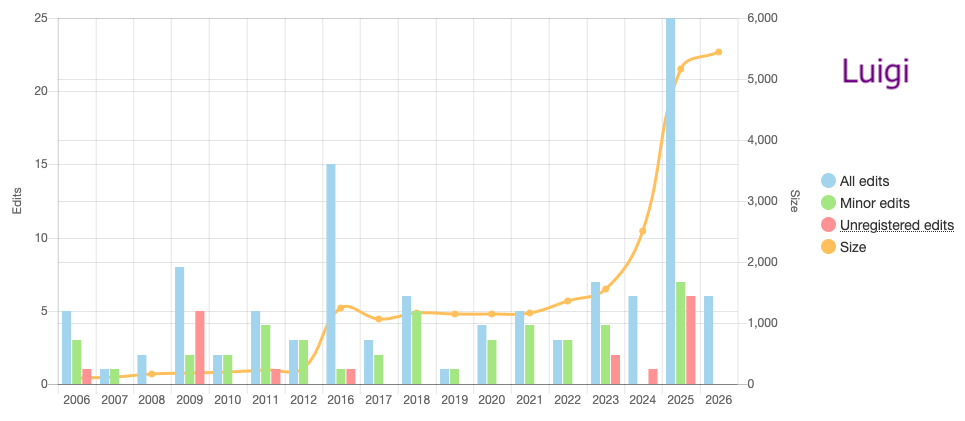
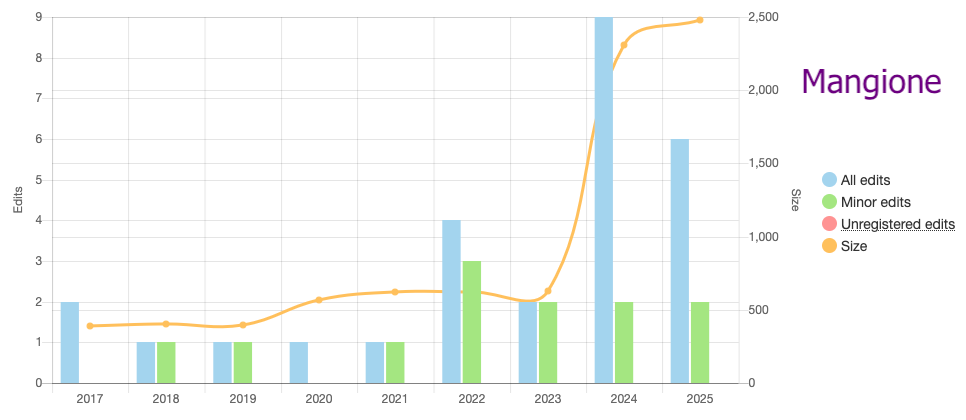
As shown above, spikes occurred for the entries Luigi (left) and Mangione (right) after the accused’s sudden entrance into the public eye in late 2024 and his steadily increasing fame into 2025. I can’t speak to why the Luigi entry was edited so many times in 2016; I even tried searching for a Nintendo-related explanation, but to no avail. And there’s another interesting observation we can make here: the spikes do not occur at the same time or in the same manner. While Mangione spiked in both page size and page edits immediately in December 2024, Luigi increased a fair amount in page size while receiving fewer edits than the year before (2023), with the most extreme rise not occurring until the 2025 calendar year for both size and edits. At least a whole month later… interesting.3
As I’ve hopefully implied by now, crowdsourcing has the potential to amplify speculative narratives beyond facts rather than stabilizing them. Moving on to Pope Leo XIV, even putting aside the way his Wikipedia entry developed—or the fact that five days after his election Wikipedians created a page dedicated solely to his family!—I recall seeing various blogs and social media posts sprouting up online about the man and his background. His Italian side was Piedmontese, they said, wait no, Sicilian! I look back on the experience and I see the world coming together to hammer out the record, collectively crafting a “the making of a pope” narrative. It wasn’t always pretty, but the changed identities and salacious affairs certainly made for a juicy story.
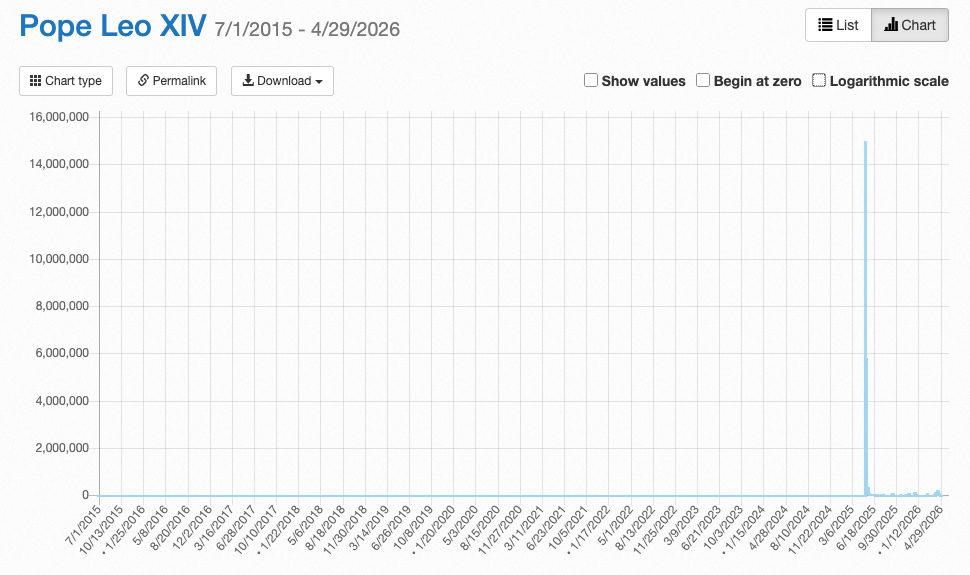
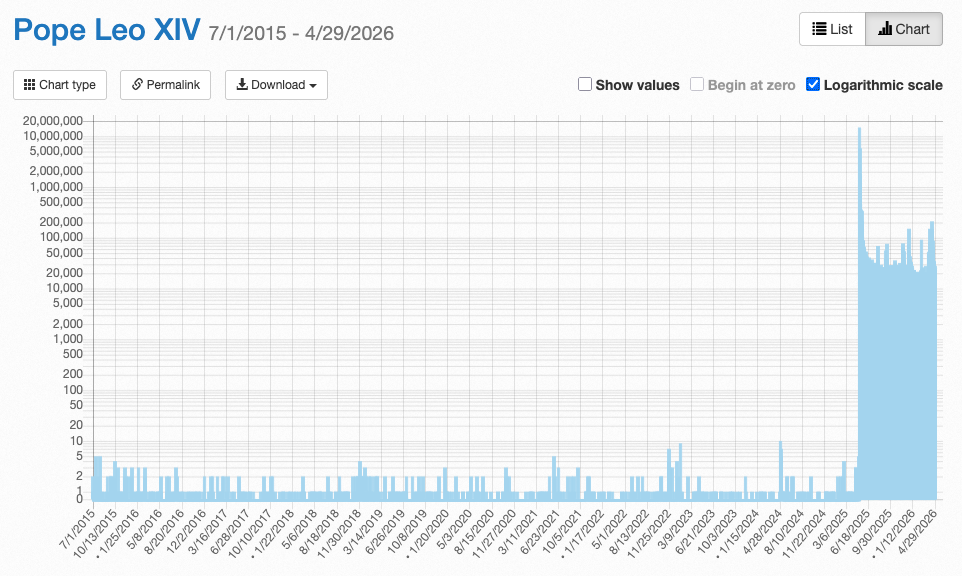
Above are two different ways of looking at the page view statistics for the page currently titled Pope Leo XIV. With the source data only going back to 2015, what’s interesting is that the page’s edit trail starts on July 11, 2017 (at which time the page redirected to “Roman Catholic Diocese of Chiclayo“), yet the charts show page views from the very beginning. I don’t have the explanation; we’re just exploring here! Still, it’s logical that the bishop of Peru’s fourth-largest city would at first seem debatably worthy of his own Wikipedia page; similarly to how Ukraine’s entry became bloated to the point of needing carve-outs for individual conflicts like the war or a particular region like Crimea, not until Pope Francis named Bishop Robert Francis Prevost a member of the Congregation for Bishops in November 2020 did a unique page complete with bio appear on Wikipedia for him. Anyways, in the graphs above I’ve shown both regular and logarithmic scales: at left to get a sense of just how much the initial interest looms over any views before and since, versus the graph at right which maintains the distinct visual difference before and after the pontiff’s May 2025 election, with sustained views since then.
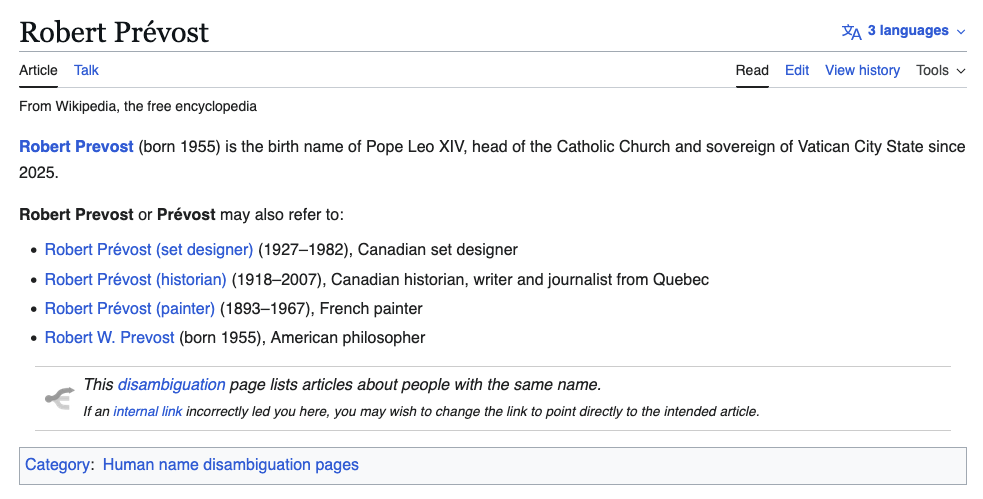
Another fun fact: in the days after Chicago’s Pope was elected, three new Wikipedia articles were created for people who happen to share the name Robert Pr(é/e)vost. As seen above, there are now five individuals listed at https://en.wikipedia.org/wiki/Robert_Prévost; though the late set designer’s page had already been established in 2006, the historian’s was created the day of the papal election, while the painter’s appeared the next day and the philosopher’s, the day after that. Despite the 2006 article being the longest-running one, it and the three newest ones are now overshadowed by the current Pope as the ‘default’ Robert Pr(é/e)vost.
So, those were the curiosities I thought I’d share! If you’ll indulge me in a few tangents before I close, I would add that all the crowdsourcing is a big part of my morbid love of documentaries featuring chronically online amateur investigators, like the streaming hits Don’t F**k With Cats or The Tinder Swindler or Crime Scene: The Vanishing at the Cecil Hotel or Tickled or more recently, The Predator of Seville. True crime has been around for years and I enjoy it on the whole, but compared to 20/20 or Dateline NBC, this more digital subgenre just hits differently… less the crimes themselves and more the process of distributed attention turning into action, I guess? The mystery building into momentum is what’s key to my interest, as much as or more so than the usual investigations working their way through the criminal justice system.
Apart from the aforementioned docus, I can think of a handful of other moments that parallel the examples discussed thus far: Courtney Love joining the search for MH370, everyone reacting to the Titanic submersible, scouring the digital footprint of this or that mass shooter or stabber (or alleged shooter of a single, high-profile individual in Mangione’s case)… But at some point it all blurs into a question about how viral attention can scale into something like participatory surveillance that we’ve helped build. For an instance of how the virality + capitalism formula reaches even the most obscure corners, it has transformed the ongoing pursuit of online child predators into a highly monetized, performative subgenre where self-appointed “predator hunters” leverage the justified social outrage against child exploitation to build massive followings. By adopting a D.I.Y. version of To Catch a Predator‘s methodology, livestreaming their confrontations on platforms like Kick or TikTok, the vigilantes generate revenue through the usual web of ad-supported content, sponsorships, and direct fan donations. We know that the digital ecosystem prioritizes chaotic engagement and clout-chasing, so long as it keeps viewers captivated and algorithms favoring their ‘content,’ but doesn’t this obscure the already-blurred line between altruistic protection and performative media production? I guess that’s life in the late-stage capitalism of the 2020s. Perhaps a blog for another time.
Turning to another way that crowdsourcing, linguistics, and geopolitics have come into play is Duolingo’s fast-tracking of its language courses in response to world crises: in 2016 at the height of the EU migrant crisis they quickly got German and Swedish for Arabic speakers going through the Incubator, later repeating this in 2022 in response to Russia’s invasion of Ukraine. The rapid, volunteer-driven expansion of the platform’s offerings in direct response to geopolitical need is a form of linguistic solidarity, and understanding how Duolingo works also means seeing how such a popular and powerful language-learning app is able to be kept free.
In summary, what I’ve tried to show is that wiki edit histories are a kind of receipt for how the world processes its own changes in real time. From Ukraine’s page shedding sections of content as the war demanded space of its own, to the ripple effects of a VP nod showing up in the edits to a Sanskrit word entry, to the frantic collective biography-writing of Catholics’ newest leader, we find traces of these events even in the data edit trails of tangential articles. Although crowdsourcing doesn’t always get it right nor is it always fast, it (usually) does get there eventually. Hopefully this has gotten you to ponder some topics and piqued your interest to go explore some articles of your own.
- The cutesy rhyme is more important than how my true assessment of Wikipedia’s quality may be interpreted. Thank you for your attention to this matter. ↩︎
- Except what does final mean? Is it ever a final product? ↩︎
- By the way, the story behind why Luigi gets an affricate [d͡ʒ] pronunciation in standard Italian while the other Romance languages developed fricatives is a great one. Worth looking up—here‘s a good chunk of it. ↩︎