
For my final entry written for the independent study I’ve pursued this semester, we’re going to peer into the world of auxlangs, or auxiliary constructed languages, which are a subset of conlangs more generally; your garden-variety conlang like Elvish or Klingon or Interlingua stands in contrast to natlangs (natural languages) like English or Tamil or Ojibwe. In “farewell to auxiliary languages” (1997), Rick Harrison provides a definition for yet another term, artlang, referring to “a constructed language which is designed for the creator’s pleasure, as a work of linguistic art…[intended for] its author and like-minded members of the audience.” Elvish and Klingon are fully artificial conlangs, invented a priori (from scratch) for their respective fictional universes just as were Naʼvi, Dothraki, and many others, making all of these artlangs—unless you consider commercial profit a disqualifying factor, at least. Other conlangs such as Interlingua or Brithenig or the big guy in town, Esperanto, were developed a posteriori, or based on already-existing languages, typically natlangs. I wouldn’t call Esperanto an artlang since Zamenhof pumped the project full of plenty of ideology, but nothing prevents a normal auxlang from being created for aesthetic pleasure, making it also an artlang.
I have previously shared my hot take that many standardized languages like German or Italian are in effect auxlangs—perhaps more specifically zonal auxlangs or ZALs—in this case meaning they’re designed to facilitate communication between speakers of existing, related language varieties. I could say ‘languages’ instead of ‘language varieties’ but dread the inevitable pedantic clapback that Italian was built on a single Tuscan language: fine, though an even more nuanced statement is that the medieval literary standard of Dante Alighieri was largely developed from the Florentine dialect of Tuscan but with influence from neighboring Tuscan dialects, the Sicilian School of poetry, and a few other sources. I also prefer to avoid using the d-word for fear of promoting glottophobic misconceptions about regional languages. Regardless,. my meditation has been this: if there is little difference between a standardized natlang and a well-elaborated auxlang, then in what ways are their codification processes the same?
To illustrate part of what I mean, I’d recommend checking out the marvelous video “Is there a neutral dialect of Spanish?” (2021) by Ten Minute Spanish. In it, the channel’s creator Dan refers to the process of dubbing for film and television as aiming to be “accessible and acceptable to as broad an audience as possible.” For Spanish-language media, “some of what has been produced has a noticeable regional sound, usually Mexican, while some of it has been so heavily massaged to remove any distinguishing features that it comes across as insipid and artificial, even ugly to some listeners.” Uh-oh, this is sounding like my recent conversation on Norwegian with Dr. Strand! In contrast, an archetypal production studio like Disney puts much time and energy into developing translations and voiceovers free of strong regionalisms yet which feel natural. Dan doesn’t advocate for emulating such an ideal standard, but rightfully opts to walk the viewer through the linguistic concept of markedness, in which a given form is marked when perceived as more unusual or complicated. Each variety of a language has marked forms that distinguish it from others, though “when speaking slowly and enunciating carefully[, as] in a formal situation or with someone of a different dialect or especially with a non-native speaker, people intuitively switch to more unmarked forms. They do it without even thinking about it.” I think of how I maintain my native variety’s /t/-flapping when I teach English, but if I notice a student struggling to understand a new word I’ve used, I’ll pronounce the /t/ fully when I repeat it. Furthermore, phonology is only one ingredient in what makes a language variety distinctive, the others being word choice, syntax, morphology, and especially prosody; thanks to the distinctive prosody of Brazilian Portuguese compared to the other languages my students speak, I can often identify a new Brazilian student by this alone, even before focusing in on their pronunciation or their name or being told where they’re from.
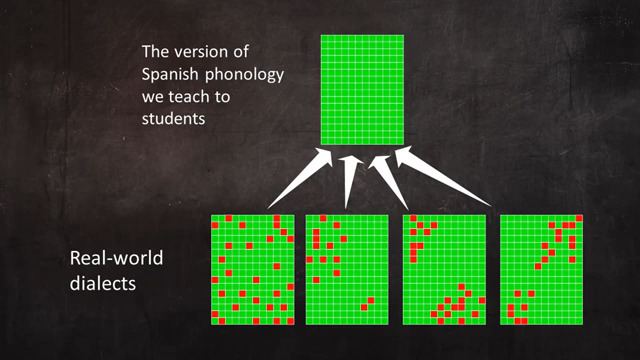
Taking the sum of a language’s dialects, Ten Minute Spanish continues: “a reasonable viewpoint is that the parent language they all share emerges from the confluence of all the dialects; it’s perceived by native speakers to exist, to influence the dialects and be influenced by them, and to tie all the dialects together, and yet no one anywhere actually speaks it or has ever spoken it as a native dialect, nor could they since it’s ultimately an abstraction.” He is also right to caution that he isn’t making a value judgement, advocating for a particular variety, or recommending any shoulds. I will be much less discreet as I move next into design principles for auxlangs.
The ninth draft of Rick Harrison’s Proposed Guidelines for the Design of an Optimal International Auxiliary Language (2001) provides a framework for elaborating a universal auxlang according to several criteria like orthography, morphology, grammar, etc. Three goals are given as paramount so that an IAL ‘must 1 be relatively easy for most children and adults to learn, 2 be able to handle both everyday conversation and highly technical information, and 3 be culturally neutral, not providing advantages like word recognition to one or two ethnic groups at the expense of all others.’ It’s a nice mix of linguistic concerns (phonology, morphology, vocabulary) and extralinguistic matters like computer manageability or the aforementioned cultural neutrality (Harrison calls out the unsurprising Eurocentrism in this debate as “chauvinistic”). Speaking of such sentiment, in a thinly veiled dig at Esperanto he writes, “The practice of treating female nouns as secondary derivatives of their male counterparts, seen in many artificial languages that were designed in the 19th century, can hardly be viewed as optimal in today’s world.” The document is a worthy read for anyone considering becoming an auxlanger—but rather than codifying globally across unrelated language families, what about doing so for a zonal auxiliary language based on a real-life family of languages of common descent? Wouldn’t this remove any concern of bias or favoritism because we’re keeping it within a known-to-be-related group? Or to spin into a different issue, we may feel bashful about cases of bigotry which exist inside the family we’ve chosen. Zonal auxlanging is rather like creating an algorithmic smoothie… so if every language (or the vast majority) going into the blender contains a certain prejudicial attitude or implied cultural construct some might find oppressive or offensive, does the auxlanger intervene to remove it before blending, or do they stay true to the family’s nature—its present linguistic reality?
In 2022, I presented at the inaugural Congrèsso Internationale de lo Romance Neolatino (CIRN) dedicated to examining the question of a pan-Romance linguistic standard which would facilitate communication by complementing existing regional standards, namely the Romance languages. The organizer was Vía Neolatina, the interdisciplinary collective led by Dr. Jordi Cassany-Bates, who for nearly 20 years has been developing and promoting a standard called Neolatino. I’ve happily collaborated with Cassany-Bates and Vía Neolatina for several years now; my presentation, titled Questiones de codificatione en lo romanzə et altras lenguas auxiliares (Codification Topics in Romanzə and Other Auxiliary Languages), outlined both auxlang codification more generally and the three components contained within a methodology I’ve developed for Romanzə, my own zonal auxlang project. A first issue to contemplate is about classification within a dialect continuum such as the Romance family: the difficulty of identifying where one language ends and another begins. If you’ve gotten that far and are ready to work out your methodology, you may worry over how schematic your standard should be (or will seem at first glance), as this can increase the perception of its artificiality and thus, its potential for rejection. The objective of Neolatino’s codification, for instance, is to develop a model with the two traits of 1 maximum potential of acceptance and 2 maximum communicative value; various criteria are outlined in a document available online.
I took a lot of initial inspiration from the pan-Slavic gold standard Interslavic in considering design criteria for Romanzə: I liked the developers’ concept of flavorizacija or “flavorization,” a type of personalization allowing for a limited amount of regionalization, and I especially admired the voting system which tries to balance the relative influence of the different branches of Slavic: West, East, and South. I’ve also been inspired by Neolatino, of course, although we have the notable difference of its all-encompassing approach versus me seeking out a way to calculate an average auxiliary standard for Romanzə, meaning that its intended aesthetic is modern, naturalistic, and well, average! Echoing Harrison’s writings about the at times cutthroat nature of the auxlanging community, it’s essential that I highlight that yes, any approach is arbitrary at a certain level. Where I seek to counteract the naysayer’s instinct to dismiss my eventual final product, however, is in distinguishing that while my system’s design is certainly arbitrary, its application needn’t be. After crafting the algorithm to generate this ‘romlang,’ the results reveal themselves with relatively few “decisions” left to be made. Does that make sense? We intuit/ascertain the solution naturally by observing the “reality” that’s come to exist within our already-created system; the results may appear internally inconsistent or chaotic because of all the exceptions which exist naturally in the real-life dialect continuum, but the output is fixed and ready to be excavated, perhaps with a small bit of schematizing to do in an effort to smooth the nascent auxlang out a little.
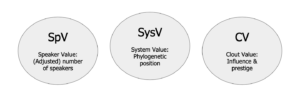
As for the votation system, rather than a simple poll which would give each language an identical share of a hypothetical vote, I combine three components which cover different aspects of each input language’s potential for influence: Speaker Value (SpV), System Value (SysV), and Clout Value (CV). Each of the values grants a certain initial vote share, and the final value is calculated by averaging them. Allow me to explain all three, darlings.
The first one, Speaker Value, is an adjusted measure of the number of native speakers of each language; it can’t be a zero-sum count since bilingualism is so common, especially by speakers of minority languages. This value is necessarily adjusted to balance out the number of L1 speakers in Europe with the L1 total worldwide, preventing the system from immediately skewing into an iberolang, considering that over 70% of all Romance speakers are either Hispanophone or Lusophone. Taking Portuguese as an illustration, the language is a modest one among many in Europe and might only pull 3% or so; yet globally, its colonial influence on Brazil and several countries across Africa and Asia means it could grab a full quarter of the vote if unchecked. I chose to weight Europe at two-thirds and the global value at one-third, which mostly preserves Romance as within its homeland but recognizes its many speakers elsewhere.
Second, the System Value measures the phylogenetic position of each language within the Romance system; if we took a simple count of languages, each of the many langues d’oïl including Gallo, Norman, Picard, and others would get a vote equal to that of a much larger, understudied macrolanguage like the misleadingly-named “Neapolitan”—the subset of Italo-Romance varieties which is also clunkily termed the “intermediate southern dialect group” in linguistic circles. To avoid this crowding out of large, undifferentiated groupings by arrays of highly similar groupings, each language should have an adjusted value relative to its phylogenetic position in the family: thus Sardinian, which branched off earliest, would weigh much more strongly than any individual langue d’oïl in France or dialetto mediano in Italy. This practice squishes closely related language varieties together into subfamilies like those of northern Italy or central Iberia. Admittedly, this does entail plenty of untangling of a yet-in-flux classification of the Romance languages.
Lastly, the Clout Value would measure extralinguistic criteria involving the language’s vitality and prestige, official use, and so on. You can see how we’ve entered subjective territory, of course, remembering we’ve reserved that right while designing this methodology. Even still, some of these criteria are hardly subjective: is the language officially recognized governmentally anywhere? Does it have a single, standardized orthography? Is it found in use on broadcast or social media? Is it present in academia with pedagogical materials and so on? If we can gather up a well-rounded bundle of domains and simply measure which ones the languages occupy, that should be enough to counter any charges of excessive subjectivity.
Taken averaged together, these three values combine for an aesthetically pleasing formula for decision-making; all that’s left is to wield the voting system on each important consideration. Once the math is agreed upon, there shouldn’t be too much debate over how far to collapse Latin’s case system, which vocabulary word to use for the verb ‘to eat,’ or whether soft C should be closer to [s] or [tʃ]. Remember when we saw how speaker count alone would distort the language to be overly Ibero-Romance? It would force ‘to eat’ to be the derivation of ᴄᴏᴍᴇᴅᴇʀᴇ when a clear majority of our voting system would indicate one derived from ᴍᴀɴᴅᴜᴄᴀʀᴇ. That’s not to say that regionalisms and the coexistence of synonyms shouldn’t be permitted, or even encouraged: nothing’s wrong with incorporating a feature into the new standard if it exists in several of the family’s languages and passes, let’s say, 40% or more of the vote? All languages have variants and auxlangs like Romanzə needn’t be an exception.
What other tools could help us build a Romance ZAL? Certainly an agreed-upon elaboration of which languages within the family not only exist, but merit inclusion in the project, would allow us to get started—and I would contend they all deserve to be. And what about databases and spectra and visualizations to aid us in making nitty-gritty decisions? If we’re using mathematical calculation to find phonological averages along a spectrum, for example, we’ll need a framework for this: what might a simplified IPA consonant chart look like if converted to a geometric graph with an x-axis for place (front-/backness) and a y-axis for manner of articulation (plosive, fricative, etc.)? I imagine features like ‘voiced’ or ‘lateral‘ would be best kept as binary values of yes/no, but at least articulatory place proceeds neatly in a more or less linear fashion. I have previously written about and presented a single-axis scale for obstruents, specifically sibilants. Dr. Geoff Lindsey has written on the vowel space‘s similarity to the color gradient and I agree that it, too, can be conceptualized and visualized as a geometric graph. Phonology therefore can be determined by combining the voting system of input languages with the coordinate systems made for consonants and vowels. Let’s take the example of the word for milk, descended from the Latin accusative ʟᴀᴄᴛᴇᴍ, with hypothetical voting values for the Romance family:
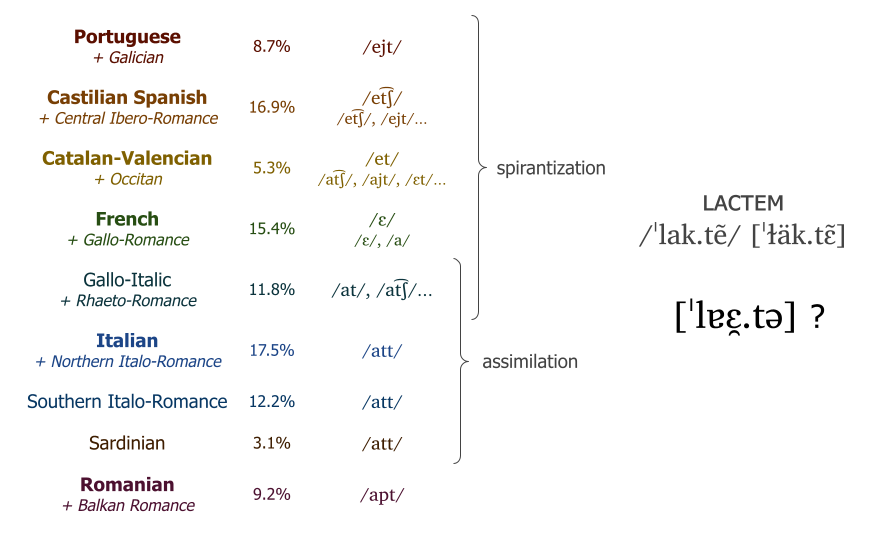
The two major concerns over ʟᴀᴄᴛᴇᴍ would be 1 the result of its syllable-final /k/ and 2 the value of the first vowel, so the third column shows each group’s outcome(s) for /-akt-/. Western Romance generally spirantized (or fricativized) the velar plosive until it lenited further by vocalizing to /j/, which often then began monophthongizing with the preceding vowel, in this case /a/. In French’s case, both occurred and the two vowels merged fully into /ɛ/, while Galego-Portuguese /ej/ is evidence of an incomplete merger. Sometimes the /j/ palatalized the /t/, as in Spanish leche or Lombard lacc, both with /tʃ/. (Note that Spanish /e/ shows vowel raising while Gallo-Italic languages maintain /a/.) In other languages like Sardinian or Italian, /k/ instead assimilated to be like the /t/: latte. Balkan varieties of Romance, including Romanian or even the now-extinct Dalmatian, show an interesting labialized result: /pt/. So where do we go now? It would seem that a small majority demonstrates the existence of historic or present /j/ instead of second-place contender assimilation; as for the original /t/, a large majority maintains it without any palatalization. Great! So we know that we’re working with a proto-form /ˈlaj.te/ and all that’s really left to figure out is the degree to which /aj/ must’ve merged along a path to a mid vowel like [ɛ~e]. We’ll plug the values [a]=0, [ɛ]=1, [e]=2, [j]=[i]=3 into two vowel spaces, V1 and V2, and calculate their weighted average with our voting system; also note if the vowel is front, central, or back. Central and Eastern Romance languages with /att/ and /apt/ would vote for a-a, Portuguese for e-i, and French for ɛ-ɛ, while some mixed votes might be necessary for a language like Occitan: a-a, a-i, etc. What’s the resulting value for each of the two slots? When I tried, the first came to V1=0.727 and a central vowel, meaning it was closest to the sound [ɐ], while V2 was a front vowel at a value just barely greater than 1, making it neatly [ɛ]. The result, then, is [ɐɛ̯], a reasonable middle stage between [ai̯] and something like [ɛ], so the only decision left is whether to leave it alone as is, squish it down to a single vowel like French /ɛ/, or stretch it out to a more decipherable /ae̯/.
If you’ve already got an orthography, you’ll want to spell this sound the same as the other words with former Latin /akt/ like ғᴀᴄᴛᴜᴍ (‘fact; done’) and ʟᴀᴄᴛᴜᴄᴀᴍ (‘lettuce’), perhaps merging this phoneme with the outcomes of original Latin ᴁ [ai̯] or later cases of /a/ + /j/, like the former -ᴀɢɪ- in sᴇxᴀɢɪɴᴛᴀ (’60’) in which the /ɡ/ dropped out early on. Remember that it’s infinitely more work to perform these calculations on each individual word rather than determining common derivations for each case type. If my algorithm consistently produces the same phonetic output within each case type, great. Done. And if a handful of types consistently share an identical result, then it looks like we have ourselves a merger: my auxlang might have words like hypothetical læte (‘milk’) and denæro (‘money’) and sessænta (‘sixty’), each representing a unique etymological case type, but they also share the grapheme ⟨æ⟩ which shows their common pronunciation today. Let’s say you want your conlang or auxlang to permit dialectal differences: go for it! This ⟨æ⟩ grapheme could flexibly be pronounced a few different ways (I wouldn’t recommend going too wild here): in our case, maybe [ɐɛ̯] or [ɛː] or even [æ].
This is enough reflection for now, I’d say, but I hope it’s given the reader some food for thought. With internet access expanding and more and more people stumbling upon niche topics of interest like this one, I can say I’ve seen a lot of proposals out there for auxlangs: in Facebook groups, on Discord, and beyond. Some are half-baked, horrendous, and contradictory, while others show vision that’s novel and clear. My own project has been largely on hiatus since grad school began, but I return to it on occasion to tinker with what else I can excavate. Some day hopefully soon I’d like to get it into a presentable shape and be able to utilize in in artistic pursuits. Until then, thanks for reading!