
Welcome to another wave (pun intended, you’ll get it later) of blog posts from yours truly; it’s fall 2024 and I am in the early weeks of a semester-long independent study I’ve titled Digital Humanities for a Popular Linguistics. For this first entry I’ll be taking a look at historical linguistics, our primary lens for this series, before we venture into its treatment online and how it manifests (or not) in language classification, codification, and popular culture. I’d like, gently, to set up a presentation of the field’s origins as well as what’s been framed as a debate between two competing models of language change, but first I find it pertinent to note some parallels between digital humanities practices and the earliest approaches to linguistics.
As you’ve picked up by now, I am a grad student in digital humanities. I’ve come to the field as a language instructor with a deep interest in areas such as Romance morphophonological change and, increasingly, broader Indo-European linguistics. I’ve been struck throughout my program by the similarities between DH and linguistics: after all, both straddle the qualitative and the quantitative. Both thrive on empirical analysis of large-scale language data, using computation to (hopefully) reveal patterns and provide new insights. Both benefit from applying visualization methods that’ll enhance our understanding. I’ve also noted that both entail plenty of collaboration; for instance, in contrast with the past, the linguists of today work alongside archaeologists, anthropologists, and geneticists to arrive at a fuller picture of such matters as the Indo-Europeans’ arrival in Europe. The world of DH is no different; as a relative newcomer to computer science, I’m acquiring the basics and fear not knowing everything, but recognize that for so many DH projects, collaboration is less of “Oh no, I need help” and more about interdisciplinary problem-solving as a collective with shared goals.
Now, onward. Or… backward, in time. It’s the eighteenth century and as the British are establishing their grip on India, a certain Sir William Jones is establishing himself in orientalist studies and in linguistics. In a 1786 speech about Sanskrit and its affinity to Ancient Greek and Latin, Jones became one of the first to speak of languages as related and resulting from parallel development; people had previously made all sorts of attempts—at times ridiculous—to explain the historical nature of language, even that all the world’s languages derived from biblical Hebrew or perhaps from Dutch. He also brought forward the concept of a protolanguage such that related languages could be the daughters of a shared ancestor language no longer spoken. Another field, that of etymology, had already been established for ages, but with “scholars” making oftentimes random connections between vocabulary words, it was far less scientific than today. Lexical similarity eventually came to be considered insufficient in claims of linguistic relationship, and an eye toward structural similarity took priority. Rasmus Rask’s (1818), Jakob Grimm’s (1822), and Karl Verner’s (1875) research of the Germanic language family advanced systematic sound correspondences as a key object of study and greatly improved our understanding of the evolution of Proto-Indo-European, the reconstructed ancestral language (or group of languages) that eventually formed various branches which in turn became hundreds of modern languages: in addition to the Germanic group are Welsh, the Romance languages, Greek, Latvian, the Slavic languages, Kurdish, Marathi, Bengali, and many more.1
As Crowley & Bowern (2010) note, linguists’ practice of referring to well-supported sound shifts as Grimm’s Law or as Verner’s Law shows influence from Newtonian physics and Darwinian biology, connoting these linguistic findings as predictable and universal. In the 1870s several scholars in the field developed into the Junggrammatiker (“young grammarians”), or in English the Neogrammarian school: a group whose belief was that historic sound change is entirely systematic and without exception. This orthodoxy would eventually fall out of favor, but certain elements remain more or less mainstream, such as the acknowledgment of diachronic (long-term) change. Importantly, with this change in the landscape it became possible for etymology to become scientific; no more “everything’s secretly Hebrew” or folk etymologies without evidence. Or at least… fewer of them taken seriously as the field grew and consolidated around best practices.
I want to pop digital humanities back into the forefront of our minds here, just as a reminder of how cool it is that for centuries, people have been creating formulas to analyze language patterns to better understand various aspects of language. When computers later arrived on the scene, researchers in linguistics sought to use them for language classification; a major effort came in the 1950s from American comparative linguist Morris Swadesh, who developed an automated approach he called lexicostatistics. He argued that by analyzing word lists of basic vocabulary across languages believed to be related and counting their shared cognates—corresponding words—to measure retention rates against the ancestral language, researchers could cluster languages based on their similarities and repeat this process to refine classifications. Swadesh built out lexicostatistics by introducing glottochronology, which posits that the loss of cognates in related languages occurs at a steady rate over time. He compared this process to radioactive decay: various rates were suggested, and the one that found acceptance was a 19% loss in basic vocabulary every thousand years.2 Chapter 6.5 of Campbell (1999) has plenty to say about the assumptions made in Swadesh’s practices and lays out several critiques better than I could; suffice it to say, language evolution has little to do with carbon 14 dating, and the assumption that a universal, culture-free core vocabulary exists is not the strongest. Bless his heart, though; he walked so we could run, and there are aspects of his work that linguists still take from. And this era is still a net positive for scientific advancement, I promise. In fact, around this same time, the “father” of digital humanities (Pun intended? Fr. Roberto Busa, the Jesuit scholar… are we laughing yet?) was laying the groundwork for the field.
We arrive back in the late 19th century, where newly developing principles stand ready to contribute to our modern understanding of language families and their interconnectedness. The primary debate was between the Neogrammarian assertion that “sound change is regular and exceptionless” and many dialectologists’ stance that “every word has its own history,” but there has also remained a contrast between two important models of language change: the family tree and the wave theory. The two pairs of contrasts don’t necessarily align neatly, and I find it valuable to tease them out when digging around in historical linguistics.
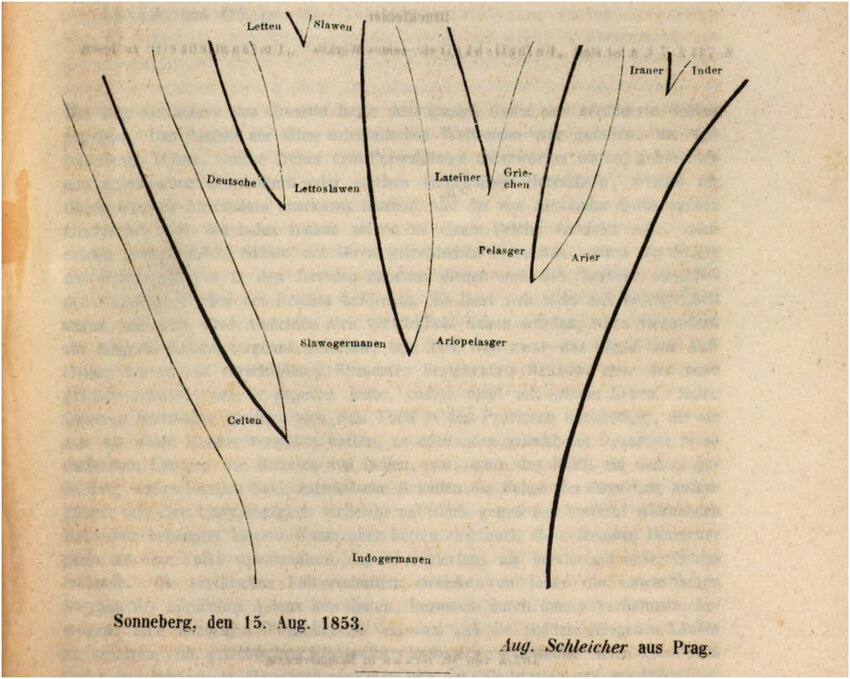
Let’s start with the tree model. If we back up slightly we reach August Schleicher, a key figure in Indo-European linguistics whose students would later become both Neogrammarians and their critics. Schleicher put forward an evolutionary model of language often connected to the development of the comparative method (more on this later), though he wasn’t the first to speak of a Stammbaum (family tree) in organizing related languages. Friedrich von Schlegel, too, had written in 1808 that “the ancient languages, whose family tree we sought to trace from the root to the main branches in the first book, are a document of human history, more instructive and reliable than all monuments in stone.”3 Schleicher took Schlegel’s ideas on linguistics and Darwin’s about evolutionary biology and applied them to languages themselves, treating them like organisms and using tree-like diagrams to show parent and daughter languages. In untangling these relationships, a major breakthrough would be the comparative method, which does the detective work of figuring out how languages are related to each other by comparing their words and sounds. The method has two key assumptions: (1) the Neogrammarian hypothesis that sound change is consistent, and (2) that there is no contact between related languages after a proto-language splits apart. While that second point is sometimes true, it frequently (if not typically) isn’t, with a continuum of dialects akin to the Romance or West Germanic families co-influencing each other for years; thus, the comparative method is deficient in accounting for language borrowings. Neglecting to address this raises questions about the appropriateness of assuming a genetic model for understanding language change and classification: as Campbell (1999) notes, “Languages do also borrow from one another,” and this would be the motivation to find alternative models to propose.4
Those who argued against the Neogrammarians’ claims made their own assertions, succinctly stated by Hugo Schuchardt—a German linguist and precursor to sociolinguistics—as “chaque mot a son histoire” (“each word has its own history”). Swiss-French dialectologist Jules Gilliéron argued that unlike the rigid Neogrammarian view, sound changes aren’t governed by phonetic factors alone, suggesting that only certain words undergo specific changes while others don’t. Gilliéron’s perspective that it can be arbitrary which words change isn’t compatible with a strict application of the comparative method as done by the Neogrammarians. Rather, instead of the “sharp linguistic splits” required under the family tree model, a rival wave model would purport that “changes take place like waves spreading outward from the place where a stone is dropped into water, traveling different distances with different stones and crossing with waves caused by other stones.”5 This explanation has its advantages, given that when studying how linguistic innovations spread it’s best to focus not on the language or dialect itself, but on the idiolect, or unique language usage of an individual speaker at a given moment in time. In that way, we’ll view a language as composed of a network of idiolects which can be understood by each others’ speakers. A change that happened “once” in a “language,” then, was actually a process of an innovation diffusing throughout many individual idiolects, even over multiple generations. Johannes Schmidt (1872) joined Schuchardt in putting forward the Wellentheorie (“wave model”) as an alternative not only to Schleicher’s Stammbaumtheorie but to the entire comparative method. I tend to agree with Alexandre François (2015) who writes that the “extreme stance” of the wave model’s proponents is inessential when following its principles, and that such a disregard “unduly throws the baby (the Comparative Method) out with the bathwater (the Tree Model). A synthesis should be possible which preserves the principle of regularity and other useful tenets of the Comparative Method, yet replaces the simplistic tree representations with a wave-inspired approach.”6
In short: trees are beneficial for conveying genetic and diachronic linguistic information, but waves are better at acknowledging the interplay of language influence which occurs in most cases, especially in contiguous areas. Fast-forward to 1988, when Malcolm Ross defines the concept of a linkage as an entity distinct from a language as he was historically reconstructing the Western Oceanic language family:
The linguistic evidence that a group of communalects has arisen from a proto language by dialect differentiation consists firstly of innovations shared by all members of the group (and probably inherited from the proto language) and secondly of innovations which link communalects in a chain or network…[thus] an innovation may arise in any communalect of the chain and spread to its neighbours, so that the geographical domains of various innovations may overlap. I use the term linkage to refer to a group of communalects which have arisen by dialect differentiation, and make an informal difference between two varieties of linkage: a chain, where communalects are typically spread along a coastline, each related most closely to its neighbour on either side, and a network, where communalects are scattered over a land area or an archipelago, typically having neighbours on more than two sides, and often sharing different innovations with several of these.7

Having for years studied the breakup of Latin into Romance, I find François’s coupling of Ross’s linkage framework with his defense of Schuchardt’s and Schmidt’s wave model compelling. When a language (or we might say a dialect continuum like the one shown above) evolves enough that its speakers can’t understand each other anymore (i.e. they lose mutual intelligibility), it turns into a linkage made up of distinct daughter languages connected through overlapping innovations. We call the boundary lines separating linguistic features isoglosses, and in a dialect continuum these may intersect rather than bunch up together neatly. It’s difficult or perhaps impossible to represent the internal genealogical relationships of the languages making up a linkage with a simple family tree. In response to the notion “that the Tree and Wave models complement each other, and should both be preserved,” François disagrees because “a tree-like structure is nothing more than a special case of a linkage – an exceptional case in which isoglosses just happen to be nested, and temporally ordered from broadest to narrowest.” He and his collaborators have developed a model they call Historical Glottometry which “aims at combining the precision and realism of dialectological approaches (especially dialectometry, from which its name is inspired) with the reasoning power of the Comparative Method.”8
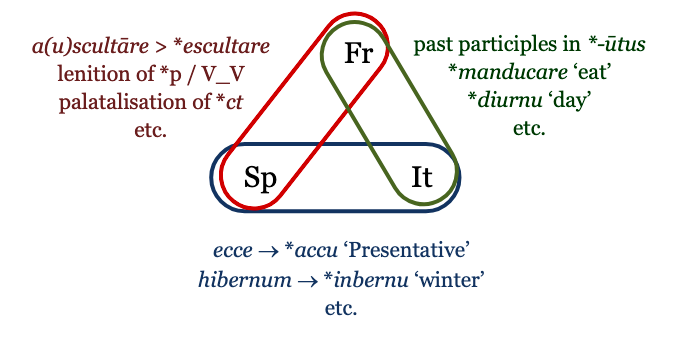
As seen above, in the case of three overlapping areas of shared innovations it becomes impossible to craft a genealogical tree that shows each subgroup splitting off from the protolanguage without prioritizing one subgroup and neglecting the other two. François’s and Kalyan’s Historical Glottometry addresses this problem in its own way, and more on this is to come in my next post, which will focus on the method and one of its critiques. I’ll catch you on the other side!
- Crowley, T., & Bowern, C. (2010). An introduction to historical linguistics (4th ed., pp. 3–11, 162–170). Oxford University Press. ↩︎
- Greenhill, S. (2013). Language phylogenies and cultural evolution. https://youtu.be/0gG04G5ncBs ↩︎
- Schlegel, F. von. (1808). Über die Sprache und Weisheit der Indier : ein Beitrag zur Begründung der Altertumskunde / von Friedrich Schlegel ; Nebst metrischen Übersetzungen indischer Gedichte. bei Mohr und Zimmer, 1808. ↩︎
- Campbell, L. (1999). Historical linguistics: An introduction (pp. 187–189). The MIT Press. ↩︎
- Crowley & Bowern, pp. 178–179 ↩︎
- François, A. (2015). Trees, waves, and linkages: Models of language diversification. The Routledge handbook of historical linguistics (pp. 168–169). Routledge. ↩︎
- Ross, M. (1988). Proto Oceanic and the Austronesian languages of western Melanesia (p. 8). Pacific Linguistics. ↩︎
- François, A. (2015). Trees, waves, and linkages: Models of language diversification. The Routledge handbook of historical linguistics (pp. 170–173). Routledge. ↩︎