
My last entry was a look at the past and present of popular linguistics online, though I hinted during my mention of Colin Gorrie that in a sense, he represents the future. A little later I want to go into that further because of the interesting projects I see him working on, like at the Ancient Language Institute or the courses he has devised. But first, let’s position this blog and set its scope (…because we exist in the context).
How does the average Joe go about finding or consuming information in the realm of popular linguistics? I mean, there’s plenty of obviously bad/ridiculous stuff out there, but some sources are less obviously dubious. With the quantity and availability of non-academically researched material far outweighing what’s locked away behind paywalls or in password-protected journals, surely there’s at least some trustworthy knowledge within easy reach? I’m interested in exploring the [fairly wide] gap between linguistic research with institutional blessing on the one hand and the sort of quackery on the other you’d find in near-unregulated environments like most social media.
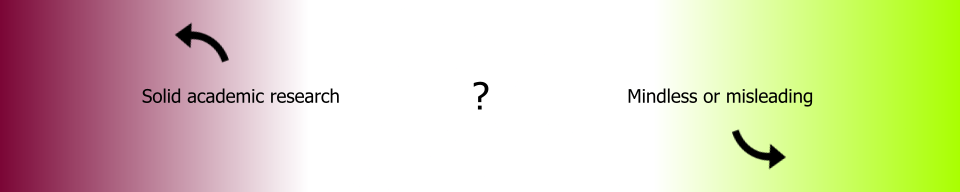
I believe that some such online spaces could be plotted onto the spectrum above if we had criteria to follow. A Facebook group with an ethnonationalist, theological, or aggrieved separatist purpose seems a more likely place to find an edgy linguistic hypothesis that vindicates a perceived cultural slight or reclaims a lost former glory, while people without any expertise react, “Wow! Cool!”; this group would appear much further right along the above spectrum. On the flip side, a loose network of undergraduate and graduate students might cultivate a well-moderated environment featuring unconventional, not fully fleshed out hypotheses about a specific language matter, producing some disagreements but also the encouragement to keep researching or exploring. There may be memes and humor amid the posts and conversations, just like our previous example community, yet this one would seem to belong somewhere left of the spectrum’s center. Certain criteria could guide how far left, but what are they? The differing sides aren’t always easily discernible; could groups sometimes even move from left to right? Or unless we’d want to look into users’ credentials: who has the advanced degree in linguistics? Or taking a step back, who is advancing an aim that situates a certain group as superior to others? What is the group moderators’ policy on what is permissible to post? I’m not an expert on criteria-forming here but would be curious to read a formulated list. The tension between the two extremes is well summed up by Jackson Crawford on his work as a popular linguistics educator: “Sharing real expertise in Norse language and myth with people hungry to learn, free of both ivory tower elitism and the agendas of self-appointed gurus.”
So sometimes quality is high and sometimes it’s low. But how or why low? What type of bad is potentially each infographic or hyperbolic tweet or fun article? Another distinction worth making, then, would be between firstly, the wildest things you’d find in the bowels of Facebook or Reddit or worse places, often tinged with nationalism or ethnoreligious supremacy if not simply well-intentioned ignorance, and secondly, the mainstream-reaching content you’ll find when new, poorly-understood, or fringe linguistic research meets lazy or sensationalist journalism. I cannot claim to have expertise in identifying and debunking any of that, but an issue at hand with popular science more generally might be a mix of not only digesting content for entertainment while ensuring its quality, but capitalism, too. A report by The National Academies of Sciences, Engineering, and Medicine titled Communicating Science Effectively states, “Effective science communication conveys both complexity and nuance, and does so in a way that is understood by and useful to the audience to which it is directed”; it’s often “not direct from scientist to audience, but mediated by organizations, media, or other actors (who often select the audience themselves).”
It’d be interesting to look back at 19th-century developments in linguistics through the lens of pop culture and pop science. Darwin’s ideas had sparked widespread interest outside academia, no? His work entered and influenced public discourse, which in turn shaped culture and helped inspire future linguists who’d later go on to break new ground and then inspire the next generation of linguists. The trees & waves debate is an excellent example of this: the rise of evolutionary biology gave people the vocabulary to treat languages in a scientific way. Hooray for that! Various theories developed in a manner which I’d liken to creating a puzzle, but instead of cutting an original picture into pieces, we create the pieces first without even having a known, complete picture at the start. Oh, and we’re building alongside people who keep accidentally creating bogus pieces that will never fit. Pieces relevant to this particular debate are the comparative method, the tree model, and the wave model; the three don’t immediately seem to fit together, so an assortment of linguists have tried to identify which are real or a sham. I’m not the foremost expert, but my studies into the matter incline me to align with Alex François about whom I wrote in the past two blogs and who points to Schuchardt (1885) as “throw[ing] the baby (the Comparative Method) out with the bathwater (the Tree Model)”.1 On the other hand, those who’d more closely follow the Neogrammarians—and their puzzle pieces like the regularity of sound change—might argue for keeping the tree model piece and throwing out the wave model piece. As I have my own reservations about stepping up to bat against such an institutionally recognized convention as the tree model, I wonder whether we should try harder to reconcile the two.2
Of course, not all advances in science pave a way we’ll continue along or remain proud of: case in point. A really illustrative example of modern linguistic theory going mainstream alongside a swirl of other, nastier ideas, I think, would be G. Bernard Shaw: looking into how we perceive the playwright today means untangling a lot of the late nineteenth century itself. Shaw dabbled in a number of areas from alphabet reform and socialism to eugenics (yikes), eventually praising Europe’s dictators of the 1930s. But more relevant here is his connection to the popular linguistics of his time; he is the namesake for a Shavian alphabet meant to represent English phonology better than conventional spelling, and knew phonetician Henry Sweet, arguably the inspiration for the character Henry Higgins in Shaw’s 1913 play Pygmalion. I wonder for how many people their only knowledge of linguistics (meant as what linguists do) comes from having watched its musical theatre adaptation My Fair Lady, eventually turned into a film starring Audrey Hepburn?
Less nefariously, sometimes a philosophical take on linguistics gets repeated enough to become well-established in both academic and non-academic circles. The most classic example is the adage, “A language is a dialect with an army and navy.” It even has its own Wikipedia article now! I’ve seen it deployed in Facebook comments to defend the legitimacy of unstandardized languages in the face of an oppressive Dachsprache, seen it (wrongly) attributed to Mark Twain, and seen it tossed out to express the futility of either language classification or standardization (or both). Even within academia we can find references to oft-repeated “facts” about language. Mario A. Pei wrote in 1949:
This type of statement is often characteristic of the non-specialist, and is equally often induced by nationalistic considerations, but it is occasionally voiced by people who ought to know better. One of my old professors of Romance linguistics, now dead, used to preface his introduction of a Rumanian speaker to the class with the words: “Gentlemen, you are now about to hear what is practically pure, ancient Latin”. Similar statements, though modified and disguised, occur in the writings of some of our best-known contemporary linguists, who describe Rumanian, Rheto-Rumansh, Sardinian, Portuguese, etc. as ‘archaic’ on the ground of one or two conservative features on which they fasten their attention to the exclusion of everything else.3
I wrote a bit in an earlier post about Morris Swadesh, a linguist who certainly benefited the discipline with his fieldwork on indigenous American languages, his attention to word lists as helpful data to collect during language reconstruction and classification, etc. but whose ultra-quantitative approach is something the field has since shown to be misguided. (Languages don’t change at a consistent rate akin to radioactive decay.) Swadesh studied under Edward Sapir alongside Benjamin Lee Whorf, who later put forward another concept I find worth discarding: the so-called Sapir-Whorf hypothesis, according to which the language we speak influences~determines the way we think, perceive the world, and so on. It argues that languages’ structures can~do shape our experiences and understanding of reality. Thus, if we speak one language, we may see and interpret things differently than how speakers of another language do. Stemming from earlier work but solidified into a concept in the 1930s with Whorf, it has faded out of the mainstream but hasn’t entirely gone away, either. Lera Boroditsky comes to mind as the top figure I’ve seen defending if not at least encouraging further consideration of the theory, and her 2017 TED Talk with its millions of views is a top sidebar suggestion and search result among talks in popular linguistics. To be fair, there’s an extreme form of this hypothesis and a softer form I’d entertain which states that it may merely influence us. I’ve seen this interest in the interplay of language and cognition (and even geographic environment) in the discourse I’ve found online, and let’s say it has quite a way to go if it is to be accepted. Speaking of the intersection of land and language…
In addition to languages, I am a lover of maps. Instagram knows this about me because my Explore suggestions frequently include maps of languages, ancient civilizations, unusual comparisons of states or countries, and plenty more. Believe me when I say that there are some wild, crappy maps out there. I took Intro to GIS last semester and have some of the basics down, and in a parallel universe I might have leaned fully into creating linguistic and cultural maps, hopefully more mindfully than some of the bored, chronically online teens who’ve produced some of the incoherent content we get fed by social media algorithms. This connects to my next point: if we know that some of the popular linguistics content online includes incorrect information or bizarre theories and the like, what can we do about it? I guess if we treated YouTube, for instance, as a marketplace of ideas (a capitalistic angle, but so apt here), then it stands to reason that the most popular content—that which best reproduces clicks—wouldn’t necessarily be the most accurate, but rather what sensationalizes, entertains, and/or attracts the most views.
I think it’s also a matter of quantity of videos. Not every niche topic has an accompanying YouTube video, and some channels hook onto a more general topic and then saturate the platform with search result after search result. A YouTube channel I omitted from my last post is called ILoveLanguages!, which has millions of views and over a thousand and a half videos. It’s now averaging two new uploads per day. By my assessment, its quality is tough to determine because while its creator Andy has certainly trodden into territory on which they are no expert and while there’re plenty of errors in their videos, there are harsher & softer takes out there on the videos’ quality over time.
One more YouTube example before I stray off. While researching historical linguistics for my first two blogs, I came across the channel Forgotten History whose five-year-old videos on the wave model of historical linguistics are essentially the only two videos that appear if you search for the topic today. “Oh, great!” I thought. “Someone has made a 12-minute video and another of 19 minutes covering this topic which interests me!” Even better, it directly riffed on an article4 by Alex François which I was already using in my research. Thinking I was about to learn from another content creator along the lines of NativLang or Language Jones, imagine my disappointment when the individual turned out to be horribly wrong on the subject matter. Quoting François that the “pattern, whereby a language is born of two parents, is not the typical scenario,” the creator brushes the assertion aside in their first video on the wave model: “No. I think it is.” They proclaim the Romance languages a counter-example to the tree model and, with zero evidence, decide that for a given word’s history, there are in fact two proto-words and that “for some reason one of the tribes became dominant…had the dominant culture,” and started suppressing the other tribe(s) whose people “were in the process of giving up their word in favor of the other proto-word, but they got stuck in the process so they created new words between these two.” How… novel! Forgotten History then states proudly, “I go further than this research paper. Take for example the origin of the word hombre in Spanish. According to academics it stems from the Latin word homo. Now, if that’s the case, why don’t just Spanish peoples use the word homo? And the reason for this in my opinion is because this word has multiple stems, so Latin homo, Hungarian ember, and possibly the word man. And hombre was created from the mixture of these words.” They promise to go into how this is possible in a later video, which, uploaded a few months later, looks into a related article I’ve also read and written about, this time by Jacques & List.5 Forgotten History throws out some ramblings about genetics (including ‘Polish people resemble Germans’) before coming to J&L’s Proto-Germanic example of incomplete lineage sorting, an important consideration for understanding the dialogue between the two articles, but dismisses it wholesale in part because they do not understand it.
*Sigh*… I should leave this user alone and move on with my life.6 Sometimes it’s just too deep a rabbit hole to merit so much trouble. Some content I’ve found even shows the creator seeming to descend into increasingly disjointed arguments, echoing the fragmented thought patterns associated with certain mental health conditions; I say this with no intent to shame or stigmatize any sort of person, of course. There was once a user in a private Facebook group about conlangs whose content I’m unable to locate, but who would regularly post their language art years ago. I remember within the span of about a month watching the content in the user’s posts go from ‘esoteric but aesthetically valid’ to something much more erratic and incoherent, even beyond the material at the link I posted earlier in this paragraph. It was a slightly unnerving moment, the social dynamic of the group briefly focused on whether the user was alright. Eventually they stopped posting.
Mmkay. Popular linguistics… Where are we going? Information is now in people’s hands, so what can they/we do with it? Undeniably, there are people online making content about languages, about history, about sociolinguistics and beyond. What about an activity people have been doing for centuries: conlanging? The hobby is so much more than Dothraki or Naʼvi, even going way back past Klingon and Tolkien to medieval abbess Hildegard von Bingen. I wish I had the time and space to cover the full scope of this world, but others have written so much (or produced impressive videos!) about it already. So let’s shift slightly from conlangs to auxlangs, or auxiliary languages, which are designed to facilitate communication between speakers of different languages, often with simplicity or neutrality in mind. These have been around for a long time yet I say they belong to the future, too.
Have you heard of Esperanto? By far the most popular~successful auxlang ever. The 19th-century linguistic and cultural ‘soup’ we’ve been studying also delivered us L. L. Zamenhof, a Polish Jewish ophthalmologist from a multilingual background who went on to invent Esperanto, intended as a world language and now spoken by millions. For many in the late 1800s, the concept or goal of an auxiliary language often centered a quasi-religious or political element; Esperanto’s contemporary Volapük7 followed a “divine revelation,” while Zamenhof’s effort strove “for humanity, for the elimination of interethnic hatred and injustice,” and for “the spiritual unification of humanity.” It seems that in the tension against the nationalism of that era, those who believed in and supported the increasing globalism of the time believed also that these languages would play an important role in an eventual internationalist order.
The latest wave of Zonal Auxiliary Languages like Interslavic (isv. Medžuslovjansky) or Romance Neolatino are a special flavor of auxlang which aim to serve a particular continuum of language varieties, not the whole globe. ZALs might not necessarily prioritize simplicity, instead reveling in the task of tapping into a language family’s morphological noise and finding an average or inclusive way to convey it all in a manner which feels neutral to speakers. I’ve followed Interslavic from afar for many years, never committing to learning it in earnest but delighting in its successes; I hurried to the 2019 Chicago International Film Festival to watch The Painted Bird (isv. Kolorovana ptica), the first film to feature a zonal auxlang, and to grand effect. I should also be forthright that I’ve collaborated with Vía Neolatina, the collective of linguists and others which has been codifying the pan-Romance auxlang Neolatino, and I hope to write more about auxlang codification in a future blog. For now, I’ll say that the newest wave of rather more internet-born conlangs and auxlangs is a whole subculture unto itself. I mean, there’s a conlanging documentary film! There’s also Linguifex, “the free wiki for conlangs that anyone can edit!”, a place where users can upload information on their linguistic creations. There are subreddits and Facebook groups and Discord servers and message boards.
Coming back to Colin Gorrie (remember him from the first paragraph?) and how I say he represents a new turn for popular linguistics online, there’s much to say. For one thing, he’s so good at presence: he may not be active on every single platform today (hey, sleepy lil’ IG!), but the man’s doing great work on Substack and Discord cultivating community, not just casting out the occasional YouTube video or posting on a blog he doesn’t even disseminate to the public (ouch). Not everyone thinks to include livestreaming either, but Gorrie is fully live on Twitch and YouTube on a consistent basis. And what does he do during these streams? …What doesn’t he do? Who thinks to themself, “Gosh, where’ve they got historical reconstruction of Middle Chinese happening live online?” “Who’s out there talking with a special guest about what matters, like motivation, mindset, and emotion in language learning?” This interactive popular linguistics of the future seems to me best exemplified by Gorrie’s work and also by the ever-popular Ecolinguist language comparison format I’ve written about; that channel has developed its own live series, too. Anecdotally, I’m also seeing a tidal wave of Gen Z users online who are taking keen interest in foreign language learning, in reclaiming minoritized regional~ancestral languages including extinct language revival, and in translanguaging.
Additionally, Colin Gorrie is pedagogically a turn away from the past and into the future. At the Ancient Language Institute where he not only teaches Old English but is Dean of Students, we find more proof of just how prolific all this can get when we look at the course offerings available! This is the first and so far the only instance I’ve seen of real academics forming a collective outside the university structure and delivering a quality product directly to language learners. Out of the ivory tower indeed, just as Jackson Crawford says—and of course the two’ve made a video together! To be precise, it’s a conversation recorded live last year with Crawford’s Patreon supporters, but in it, Gorrie says the ALI seeks ‘to incorporate the findings of modern second language acquisition research into the teaching of ancient languages,’ teaching ancient languages “as if they were modern languages,” with even most modern languages ironically not taught in exactly the way we’d say they should be.
I could say that some of this is unique to popular linguistics, but that claim would be too insular of me to make. There are internet users around the world in near-constant communication about a range of topics, innovating the manner of their interactions as well as the setting. Gone are the days of one or a few websites~platforms dominating the more niche interests (goodbye Yahoo! Groups) or people sitting at home thinking they’re alone in their hobby. Still, with language itself beginning to morph into new possibilities before our eyes, one has to admire the certain sparkle of a future on the horizon in which we expand the limits of what humans have ever done before with regard to communication.
- François, A. (2015). Trees, waves, and linkages: Models of language diversification. The Routledge handbook of historical linguistics (pp. 168–169). Routledge. ↩︎
- How well would we be served here by yet another analogy… that the linguistic truth we seek is like wave-particle duality? ↩︎
- Pei, M. A. (1949). A New Methodology for Romance Classification. WORD, 5(2), 135–146. ↩︎
- See footnote 1. ↩︎
- Jacques, G., & List, J.-M. (2019). Save the trees: Why we need tree models in linguistic reconstruction (and when we should apply them). Journal of Historical Linguistics (Amsterdam. Online), 9(1), 128–167. ↩︎
- Why do I care so much about this misinformed person? Why does it feel like such an affront to the dignity of my research? I may just be spiraling out because I don’t feel there’s sufficient popular exposure of the tree vs. wave model discourse, yet here’s the one person talking about the topic and it’s utter nonsense. ↩︎
- Volapük is more or less Esperanto’s contemporary, yes, though it preceded by seven years or so. Henry Sweet wrote about it—yes, the man I mentioned earlier, the one we imagine when we watch Rex Harrison berate a poor flower girl with a strong Cockney accent! ↩︎