
For this next entry, I’d like both to move our discussion forward into the digital age and to zoom out into a broader look at popular linguistics: its treatment online. I don’t know of anyone doing scholarly work on this, and my attempts to search for it tend to bear results veering off into either the linguistics of speech on the internet or teaching linguistics remotely. But how about glossing over some of the main figures—whether formally trained in linguistics or not—who regularly produce language-related content online?
Maybe it’d help to come up with some categories. Some individuals focus more on general linguistics for the masses, or on comparative/historical linguistics, on phonetics/phonology, on the philology of ancient and medieval languages, on conlangs & auxlangs, on teaching their native language to the Anglosphere in engaging ways, on teaching the Anglosphere its own language’s history and complexities… the list really goes on. And that’s just categorizing subject matter; what about manner? Video seems to be the catchiest and most common medium these days, with YouTube having an early lead while social media (X~Twitter, FB, IG, TT) catches up with its typically shorter-form video content. Some creators are cartoonists or animators while others ‘star’ on camera themselves, either alone in their bedroom with a ring light or trotting the globe with flashy drone footage. Two in particular from my list include plenty of nature clips to accompany their linguistic theorizing. On that note, some clearly receive help in terms of budget, writing, and editing, while others… don’t. And what about frequency? Some pump out near-daily content on Instagram to maximize its monetization, whereas for others it isn’t about quantity and they may go into e-hibernation for months or even years. I won’t claim to have developed a comprehensive system of subgenres, so I’ll let those hang back while we move on.1
Quick off-topic: Special shout-out to musician Bill Wurtz who captivated the world in 2016 with his nine-minute video “history of japan” which mixed history into his super distinctive music and humor, then again a full fifteen months later with “history of the entire world, i guess” (length 19:25), sprinkling just a few short clips of less than a minute during the intervening period. Music theory is another fascinating corner of the YouTube ecosystem with plenty of its inhabitants having crossed over into comedy (at least one even briefly reaching into language-adjacent humor).
There are other formats besides video, naturally: infographics, maps, blogs, vowel diagrams, and of course podcasts (as great a time as any to mention how my fifth blog was a podcast about a podcast, showcasing Lingthusiasm during my first semester). I want to stick for now with YouTube, though, and walk through some of the channels I’ve noticed and appreciated through the years for one reason or another, before I provide a stats rundown on a fuller list.
YouTube creators
NativLang: Let’s start with one of the first channels that I can remember subscribing to and watching intently, one I think does a great job of representing the broader genre. NativLang2 is one of the earliest big linguistics channels on YouTube, created in late 2009 and now with over 100 million video views. I love that from their earliest days, they’ve curated playlists of their videos to act as little mini-courses such as introductions to grammar and the Romance languages, “Thoth’s Pill: an Animated History of Writing,” and even the language of computer code. I think what sparks joy for me about NativLang is that with plenty of videos, there’s a fairly evident (and admirable) evolution in their aesthetic style, and it’s fun to see how they’ve come to embrace storytelling and a certain pacing that is so on point. I adore their animations and one thing that’s never wavered is their soft, good-natured vibe. I’ve incorporated their video on aizuchi in my ESL curriculum for years.
Distinctive aspect: NativLang has the individual video with the most views on my list: 2020’s “What Ancient Egyptian Sounded Like – and how we know” has over 15 million views!
LangFocus: Surely you’ve seen thumbnails containing Paul’s face before, dotting your “suggested videos” sidebar with enticing titles about language histories and comparisons. Since 2015, the Langfocus channel has been producing videos about language learning, relationships between languages, or what makes certain languages fascinating. Many of Paul’s earliest videos introduce Hebrew and Tagalog, while his most popular ones are often about Romance or Slavic languages (or both). I’ve shown a video or two in class, mostly the ones on Esperanto or Anglish as a fun experiment on intelligibility, and I must affirm the educational value of this channel as a whole even when the occasional error has cropped up. The videos have often featured contributions by experts who supply audio recordings and other key info, and the most recent uploads have been about Chinese and Japanese speakers being able to read each other’s languages (in a riff on the format popularized by Ecolinguist; see below).
Distinctive aspects: LangFocus has two! Handily topping the list of subscribers at 1.5 million subscribed, the channel has also raked in the most total video views with 183,532,677 as of October 1st.
Ecolinguist: Norbert Wierzbicki bills himself as a Polish teacher and language content creator, and his videos on language intelligibility have grown into a successful project and community. His earliest videos starting from late 2016 stuck to the Slavic language family with a few series on learning languages like Polish and Czech, two “Growing up Bilingual in America” videos, and an interview with the creator of Interslavic. By this point it’s 2019 and now come the videos that I think make this channel shine, for two reasons: first, the exploration of small, lesser-known (Kashubian, the Trentino dialect of Venetan) or even dead (Latin, Gaulish) languages. Second, of course, are the famous experiment videos with titles roughly matching the formula “Can X and Y speakers understand each other?” The most common format involves a game in which one speaker provides vocabulary words or full sentences which three speakers of related languages must interpret (or at least guess) the meaning of. I have occasional gripes (Sicilian was not managed well), but casting such a wide net will inevitably produce more than a few imprecisions. Still, it’s an admirable channel with hours of content that are worth viewing because you can play along with the three contestants until the answers are revealed.
Distinctive aspect: While not showing any measurable superlatives on this list, the Ecolinguist channel definitely earns the title of “most distinctive format.” There is also clearly a community among the viewership: active in the comments section, on the channel’s Discord server, on Instagram, etc.
LetThemTalkTV: Here we have a well-established channel primarily for English language learners, but which also includes plenty of videos about some pretty interesting aspects of English’s history. LetThemTalk’s made-for-student-audiences nature is evident from the phrase “how to” appearing literally dozens of times in the titles of the channel’s 258 videos, which are typically hosted by experienced English teacher Gideon and occasionally featuring guests who offer insights from a native speaker’s perspective of a particular accent or dialect of English. It’s not one of my go-to channels (conceivably because I’m not a prescriptivist nor an English language learner), but the videos will punctuate my sidebar recommendations from time to time and provide an interesting 15 minutes or so.
Distinctive aspect: In addition to being the oldest registered channel on my list3, LetThemTalk is also a school in Paris which offers English and French courses.
Jackson Crawford: Alright, we’re entering some slightly uncharted territory now:4 here we reach someone verging on celebrity status to their following. Jackson Crawford, Ph.D. is a specialist in Old Norse language and mythology, describing himself on his website as a public educator sharing real expertise “free of both ivory tower elitism and the agendas of self-appointed gurus.” This follows several years as full-time faculty in Scandinavian Studies. His YouTube videos cover elements of Old Norse, historical linguistics, runes, and dispelling misconceptions about ancient Nordic culture, typically featuring the beauty of Colorado’s natural landscapes as the backdrop. This “Viking cowboy” aesthetic has led to commentary going as far as calling him “language daddy” (that voiceless labialized velar approximant is just so charming!), a designation also applied to Simon Roper (see below). A stand-out video on the Indo-European languages includes something I’m shocked not to have seen anywhere else, which is Crawford’s “sunburst” family tree design for the Germanic family, appearing at the 21:00 mark. (Quick/shameless plug for my recent blogs on areal/wave depictions as superior to hierarchical tree models…) I appreciate his frequent collaborations with others in the linguistics youtubeverse, and would probably even credit him for having contributed to my increasing interest in the Germanic and larger Indo-European families as opposed to Romance alone.
Distinctive aspect: By far, Jackson Crawford has the most video uploads of any channel on the list, with 1,132 by the first of October. As a possible explanation of why he is so prolific, we might remember the YouTube + Patreon model and its pros and cons for an academic in the humanities. Crawford has been quite transparent about both his career in academia and his personal life, and I certainly admire him for sharing those with us, his audience.
Simon Roper: (whispering) I don’t have favorites, I don’t have favorites, I don’t have favorites. Next up, Simon Roper, folks! For the past eight years, this channel has been delivering high-quality yet unpretentious content on Old through Modern English, historical phonology and language reconstruction, anthropology, and some truly thoughtful takes on other matters such as historical accuracy and cultural relativism. I’ve been watching for a few of those years now, to the point that my partner knows Simon Roper by face when walking past a screen playing one of his videos; I’ve even happily shared his channel with the professor who taught me textual criticism. It’s worth mentioning that Roper is open about not claiming to be a linguist (he has a master’s in archaeology) and the at-times speculative nature of his work, but his videos are nonetheless respected as educational by academics.5 I find his work thorough and insightful, and even his non-linguistics content captivates me. For a more quintessential video, I would recommend “Monarchs’ Accents through the Ages” or his solid explanation of the LOT-CLOTH and TRAP-BATH splits.
Distinctive aspect: While Simon Roper doesn’t mathematically attain any superlatives on my list, his channel’s distinctive aspect is its tranquil aesthetic, which I’d describe as affable layman’s linguistics in a cozy English home. If he isn’t himself on screen in a vintage sweater with a cup of tea, his voice is overlaid on either a beige background with relevant text or backyard footage of a bee softly buzzing around some plants or the rain softly accumulating into puddles. This young man (but old soul) is my ideal hygge experience. Like with Jackson Crawford, there’s also a modest little thread through Roper’s personal life which is brilliantly balanced between “this is simply a real person existing and producing content” and “Simon is someone I wish well during the difficult times in his life to which I’m privy.”
polýMATHY (Luke Ranieri): This next individual actually has two channels: polýMATHY and ScorpioMartianus. Both share the focus of spoken Latin and Ancient Greek, though while the latter’s content is typically in either ancient language itself, polýMATHY is much more expansive in scope and mostly in English. The older channel, ScorpioMartianus, began its earlier years with daily news, song covers, and more in spoken Latin. Part of Ranieri’s renown, certainly to the Anglophone ear, is his way of producing organic-sounding speech in both Classical and Ecclesiastical Latin. I list his younger channel here despite its fewer uploads because it has many more views and subscribers. polýMATHY evaluates the Latin in video games and movies. Ranieri is another creator with many collaborations through the years (including with Ecolinguist, Crawford, Roper…), and perhaps my all-time favorite video of his is a 46-minute discussion of the retracted S sound of Latin and Greek with Raph Turrigiano who, despite not having as active a presence on YouTube, easily earns my respect as a scholar in the field of historical linguistics.
Distinctive aspect: Ranieri’s distinctive aspect might be his frequent appearances in multiple locales and on multiple channels. In many videos he’s at home in front of his mic, his bookshelves behind him, but then in others he’s walking among the ancient sites of Rome, no now he’s at the Vatican conversing with priests, oop, now he’s in Times Square dressed as a Roman soldier.

Dr Geoff Lindsey: My next channel here is such a treat. Dr. Geoff Lindsey has his own site (with extensive blogging) and has co-created the CUBE online pronouncing dictionary, the searchability of which can come in handy with English phonetics. One thing I love about Dr. Lindsey is that he isn’t afraid to stake out strong opinions even when they go against the mainstream: he has plenty to say about poor phonetic transcription and about /ə/ and /ʌ/ specifically (1, 2). His video on the vowel space is a masterpiece. There are also several videos which effectively engage phonetics with pop culture, whether he’s addressing vocal fry or the royal family. Who knew that saying Kamala is tough for the Brits?
Distinctive aspect: Dr. Lindsey is the phonetics god of my subscribed channels, hands down. I’ve said it already, but I’ll say it again that his conception of the vowel space is a breath of fresh air. I’m happy to see that he has a Patreon and possibly a little editing help, and always look forward to viewing his next upload.
Xidnaf: Despite only having 44 videos, I actually like that Xidnaf’s body of work is of manageable size while still thoughtfully exploring the complexity or not of writing systems, Proto-Indo-European and other ancient languages, and even some controversy within the field. It seems the channel’s heyday has passed (that was 8–10 years ago), but thankfully the treasures remain for our viewing pleasure even now. There was even a fan Reddit.
Distinctive aspect: After NativLang, Xidnaf is up there among the top linguist animators—no offense or erasure meant for K Klein or LingoLizard, of course!—and like the other two I name here, it’s neat to see a young generation of proud language nerds with endearingly drawn and voiceover-ed animations. Their videos dovetailing, they paint a picture of which aspects of linguistics the new cohort are prioritizing, showing an outward-facing interest that isn’t simply the Western classics for the umpteenth time.
Ten Minute Spanish: Branching off slightly from the previous channel and moving into a language-specific channel, Dan of Ten Minute Spanish produces some seriously solid videos about topics I’ve found captivating, so that sometimes I even forget that I’m watching a channel that bills itself as language-specific. The video entitled “Is there a neutral dialect of Spanish?” is just such a solid piece, and the way Dan visualizes his argument is not only effective but refreshing; it makes me want to apply such an approach to entire language families and see where the results take me! I’ve also enjoyed the dialectological video on S-reduction, which has been pertinent to my research on Romance.
Distinctive aspect: While being a language-learning channel, Ten Minute Spanish does not lose sleep trying to play up the sexier tropes of the YouTube genre; instead, you’ll be expected to pay attention to detail, to grasp some higher-level concepts, and if you can be responsible enough to do that then you’re more than welcome to come along for the ride.
Last up, Colin Gorrie. This guy is special. Per his profile, topics include “Old English, conlangs (constructed languages), linguistic theory, etymology, and learning ancient or often obscure languages.” The videos are mostly livestreams that’ve either occurred live or been uploaded after the fact; he has quite a few different series like one called Conlang With Me in which he develops constructed languages during live streams, or another called Historical Linguistics Challenge where he must reconstruct proto-languages on stream. He aims to keep these sessions both informative and entertaining, allowing viewers to learn while enjoying the content, typically things you wouldn’t expect. I mean, “Let’s Reconstruct Middle Chinese“? Conlang tips on naturalistic vowel inventories? Yes, please! I think it’s so great that Gorrie doesn’t shy away from conlanging, as it can get a bad rap, because despite the large number of conlangs out there that’re arguably quite poorly crafted, the hobby remains a gateway to linguistics for many.
Distinctive aspect: Per his website‘s tagline, “Bringing linguistics out of the ivory tower,” we get the clear picture that Gorrie is representative of the sort of popular linguistics I’ve been writing about. I would describe his distinctive aspect as really just… the future of it all! While he’s not the only one with a community that spans from YouTube and Twitch to Discord and Substack, the fact of his existence in multiple unique niches and their combinability means this all could easily spin off into other areas like worldbuilding or auxlanging, topics I intend to touch on later this semester.
So… who’ve I excluded from specific shout-outs? My deepest apologies to the RobWords and Connor Quimby fans, but there’re just so many channels out there and I feel this blog already took too long to compile. I’ve also (unfairly) excluded many non-English language-learning channels, but I must note that Elena of Linguriosa is phenomenal, and two years ago I was briefly hooked when she teamed up with Portuguese With Leo, French mornings with Elisa, and Podcast Italiano for a multi-channel collaboration called Liga Romanica. I still more or less follow Linguriosa for her interesting content, and despite my comprehension not being at the highest level, it’s a fun exercise to keep the subtitles in Spanish and learn about medieval pronunciation or geographic dialectal differences. Many others deserved mention in more detail; check out the full YouTuber table here before additional commentary below:
| Channel | Created | Subscribers | Uploads (2024/10/1) | Total video views (2024/10/1) | Top video views (2024/10/1) |
| NativLang | 2009/12 | 1.04M | 205 | 104,815,830 | 15M |
| LangFocus | 2014/08 | 1.50M | 202 | 183,532,677 | 7.6M |
| Ecolinguist | 2014/10 | 352K | 326 | 49,925,578 | 3.5M |
| LetThemTalkTV | 2007/05 | 597K | 258 | 41,653,880 | 4.6M |
| Simon Roper | 2013/01 | 234K | 183 | 22,949,860 | 6.8M |
| Jackson Crawford | 2012/05 | 286K | 1,132 | 24,416,188 | 2.4M |
| polýMATHY | 2015/05 | 236K | 233 | 24,899,897 | 5.3M |
| Dr Geoff Lindsey | 2009/03 | 276K | 60 | 22,245,576 | 2.2M |
| Xidnaf | 2012/01 | 271K | 44 | 28,839,085 | 9.3M |
| Lindsay Does Languages | 2012/04 | 41.7K | 375 | 4,189,483 | 334K |
| Connor Quimby | 2018/06 | 15.6K | 49 | 980,501 | 146K |
| Ten Minute Spanish | 2019/02 | 13.8K | 84 | 658,964 | 120K |
| Martin Hilpert | 2007/08 | 32.6K | 121 | 2,048,054 | 168K |
| Alexander Arguelles | 2008/10 | 102K | 214 | 9,304,873 | 2.4M |
| RobWords | 2020/06 | 565K | 74 | 47,854,110 | 3.4M |
| K Klein | 2015/10 | 118K | 59 | 11,090,573 | 891K |
| LingoLizard | 2022/05 | 57.4K | 31 | 7,368,696 | 2.5M |
| languagejones | 2015/10 | 136K | 106 | 7,149,286 | 1.1M |
| Learn Hittite | 2010/12 | 5.48K | 71 | 265,245 | 37K |
| imshawn getoffmylawn | 2020/02 | 29.8K | 109 | 2,371,284 | 530K |
| Podcast Italiano | 2017/10 | 208K | 397 | 14,575,826 | 1.0M |
| Linguriosa | 2019/09 | 765K | 360 | 98,165,213 | 3.8M |
| Colin Gorrie | 2009/01 | 6.49K | 261 | 367,077 | 42K |
Another way I’ve missed the mark is simply those who don’t use YouTube much for their work, or those who feature on bigger channels like the [increasingly handsome] Erik Singer on WIRED or Dr. Erica Brozovsky on PBS’s Otherwords. Even Vox has dabbled in linguistics through the years, but not with a consistent host. Or sometimes the YouTuber dabbles in language topics without it being the focus. Or sometimes the content is a little too deep in troll territory for me not to shy away from writing about it.
Then there are the creators who do use social media, such as Facebook, Instagram, Twitter~X, Tumblr, Reddit, or TikTok, often cross-posting among them but maybe not focusing much on YouTube. Others may stick to their own website and rarely stray from it. Deciding who to consider ‘sufficiently’ a YouTuber above or something else below was of course an arbitrary decision made by me and me alone, perhaps uninformedly6.
Others
Let’s take a look at some other creators I’ve found online and whose work I’ve admired.
Starkey Comics: This Facebook page by Ryan Starkey seems to work in tandem with his website, and I’ve enjoyed his content for years. In the about section of his Patreon he writes, “My hobby is creating colourful comics and infographics about language, history, science, and culture. Basically my goal is to make people think, laugh, and learn, by displaying complex information and ideas in appealing and attractive ways.” Well said. I highly recommend his Linguistical album on FB or his blog posts “The ABCD Family Tree” and “A Brief History of British and Irish Languages,” for the latter of which he’s created crystal-clear maps that I love in a sped-up GIF version.
Quick note that it’s fascinating how different media (as in mediums) are best suited for different purposes on different platforms, so a more visual person might create animated videos, static infographics, or etymological maps, while others may prefer to podcast or hop in front of a camera to engage an audience that way.
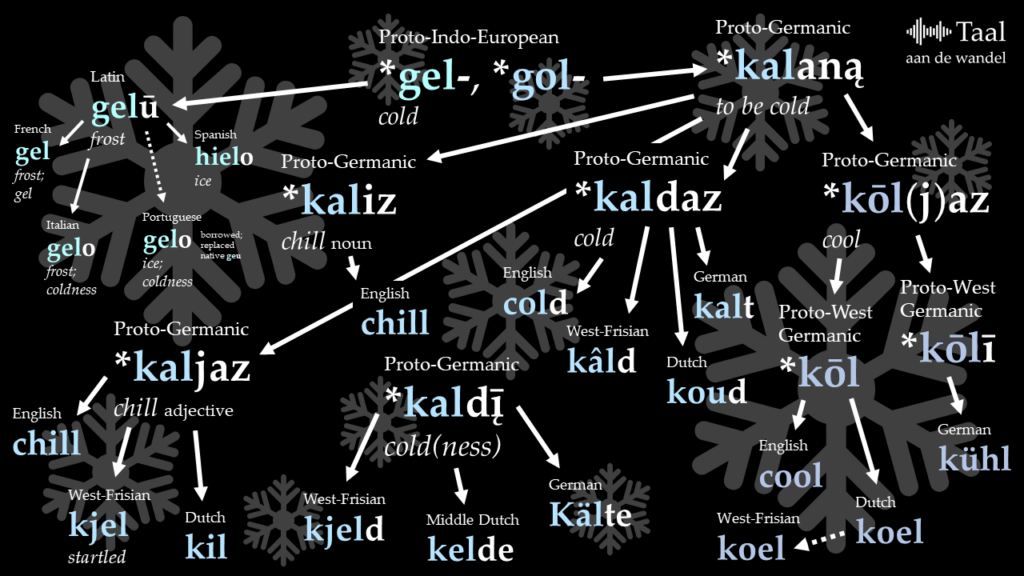
Taal aan de wandel: Another fantastic creator is Yoïn Van Spijk, and I had to hesitate in choosing which page to link because he is on multiple platforms. I’ve linked his Facebook page, Taal aan de wandel (“language on the move” in Dutch), but his Tumblr seems to be a hub for all his work and I first noticed him on then-Twitter, and he’s on other networks like IG, too. Van Spijk’s dynamic infographics on etymology and language change are simply awesome, and he occasionally make them even more dynamic by audio-narrating them. He’s very engaging with the followership he’s cultivated, as I see him in the comments either chatting about the topic (or oh-so-politely discrediting the inevitable lunacy a person may throw against his well-researched work). He’s been on a podcast discussing Proto-Germanic, has concisely displayed Grimm’s Law, and has even applied sound change laws to Old English words which have died out by the present, showing their hypothesized modern forms—we could’ve had frith “peace” and okern “squirrel”!
TheEtymologyNerd: Okay, technically also a YouTuber and with more video views there than anyone I listed above, but also so much more! Adam Aleksic has nearly a billion views across platforms and regularly cross-posts TikTok-formatted videos on there in addition to YouTube Shorts and Instagram. He is so stunningly intelligent and makes short-form videos (speaking at a rapid pace!). His infographics including a Romance languages map I respect as simplified but not bad, he’s built an interactive etymological map of country names, and he even writes posts on Substack about areas like forensic linguistics in politics. Just call me TheEtymologyFan.
There are some others besides TheEtymologyNerd that I’ve primarily learned about through Instagram: I happily follow human1011 (IG/TT/YT) for his endearingly nerdy reels and Jonas Fine Tan (TT/IG) for his playful Singaporean-Oxfordian antics, plus Linguistic Discovery (site/IG/YT) who is truly pumping out plenty of content on all things linguistics. For my extensive interest in the dialectology within Italy (I cannot bring myself to say ‘Italian dialectology’ lest someone misunderstand my intentions), I lean into accounts like DeVulgare (IG) or Lingue d’Italia (YT) but most of all, the [private] FB group Lingue regionali e minoritarie d’Italia which contains some really promising, bright young minds in Italian academia who’ll hopefully help reformulate the field of linguistics in Italy. There are also excellent language-specific accounts on IG and beyond for the Cademia Siciliana (Sicilian), Academia Bonvesin de la Riva (Lombard), or many talented individuals I cannot name all of but who specialize in their minoritized Romance language whether in Italy, Alpine borderlands, Galicia, etc.
I could go on and have certainly not covered it all, but I hope that anyone who’s read this hefty post can find something interesting to check out if they’re interested in linguistics, historical or otherwise, especially when popularly divulged. Considering that my audience for this is currently set to a handful of university contacts, I feel funny encouraging people to leave a comment, but all are welcome to share their thoughts or favorites or to mention anyone I left out.
- As an aside, I’ll say it’s tough to draw a line between ‘straightforward language instruction’ and ‘language-specific content consistently supplemented with or informed by the field of linguistics.’ I’ve included a few users who primarily teach a language but merit mentioning by virtue of how they incorporate more than simple language + culture. ↩︎
- All of these creators have names for both their private and public lives. Since this blog is about their public-facing content, unless I’ve deemed that they’re generally open in public fora about their personal names, I’ll stick to using channel names or pseudonyms. ↩︎
- To admit a technical flaw in my calculations, I didn’t note the oldest video for every channel, so in the case of LetThemTalkTV, there’s a big gap between the channel’s registration in May 2007 and its oldest extant video from November 2012. A glance at Martin Hilpert‘s oldest videos, for example, would show some adorable family clips before he uploads “Linguistic motion charts” in April 2011. ↩︎
- Maybe I should’ve framed this entry as the nine circles of hell à la Dante’s Inferno…? Ah, well. ↩︎
- Mossman, K. (2021, October 14). Simon Roper: the 23-year-old reconstructing the past for millions of online viewers. New Statesman. https://www.newstatesman.com/culture/the-culture-interview/2021/10/simon-roper-the-23-year-old-reconstructing-the-past-for-millions-of-online-viewers ↩︎
- Is uninformedly a word? I’m inclined to argue yes. ↩︎