In April of this year I was able to present a poster at the Graduate School’s 17th annual Interdisciplinary Research Symposium. If you’d like to skip ahead to the poster itself, see it embedded further below!
The small bit of research here is in fact the tip of an iceberg of extensive study I’ve conducted throughout the years to the history of English and to its neglected yet persistent orthography. My main questions here were whether we could reform it without losing its inner philological richness and what making that determination would entail. Those who would reform English orthography by “spelling the way you speak” overlook the issue of each person’s writing becoming potentially incomprehensible to speakers of a different accent, so any reform with hope of success requires a knowledge both of English diaphonemes—abstract groupings of sound-variants from the same historical source—and of their etymological, or historical backgrounds. To devise a single, standardized writing system with reduced complexity, little to no irregularity, and minimal disorientation for present-day readers necessitates an untangling of English’s diaphonemes and their conventional written representations. This interdisciplinary study marries an informed humanities approach to language planning with some (very) basic computation, so smoothing out English’s traditional spelling becomes a less complicated task.
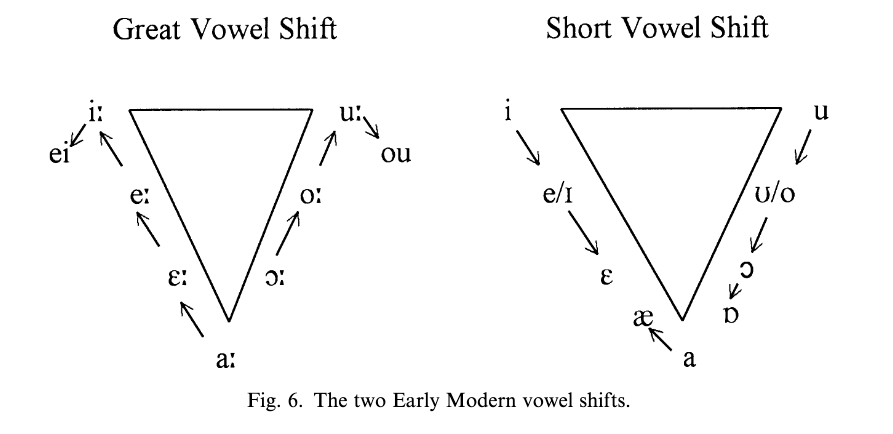
The Great Vowel Shift is the most common term which describes the relatively rapid evolution of vowels at the tail end of Middle English, portending the arrival of Early Modern English. This period when [most of] the vowel-change dust was settling is roughly where English spelling is still fossilized, and when we start determining diaphonemes and making decisions about [re]standardizing spelling, I say we should be looking a bit afterwards from there.
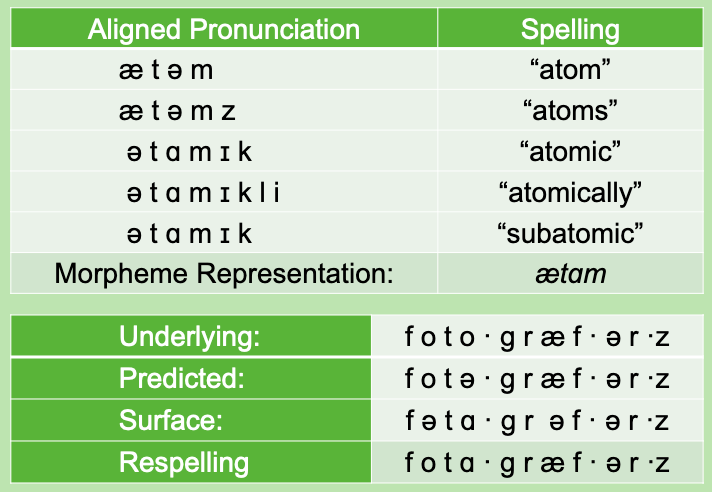
Nicolai and Kondrak have already done great work on this; they come from a computer science background and presented a wonderful paper and poster comparing several orthographic systems by measuring morphemic optimality against orthographic perplexity. In the above image clipped from their poster, they wisely represent multiple derivations of the word atom and show its underlying morphemic components: ætɑm. In this way, whether stressed or unstressed, vowels are represented by a phonologically and etymologically relevant grapheme instead of e.g. lumping together the frequent instances of schwa /ə/ with a single vowel letter.
Using both a synchronic and diachronic phonological lens across dialects from Middle English into Modern English, I mapped out the English diaphoneme system by assembling lexical sets (using John Wells’s well-known sets as the basis) which cover the full range of sound changes across particular phonotactic environments. After a careful look at the evolution of the sound system, I considered available letter combinations to create graphemes for each diaphoneme. By being sure to assign each grapheme to just one diaphoneme, complexity as measured by grapheme-phoneme correspondence (GPC) is reduced.
After hours of combing through English’s vowels to differentiate its diaphonemes, which I determined based on pronunciations roughly within the span of the fifteenth through seventeenth centuries, I reached the results in the below chart. I follow Dr. Geoff Lindsey’s affirmation that most of our language’s “long” vowels are in fact diphthongs and use the terms lax and tense instead of short and long, and I also did my best to balance between separating out vowels which precede postvocalic R and keeping those diaphonemes as near as possible to their regular origins.
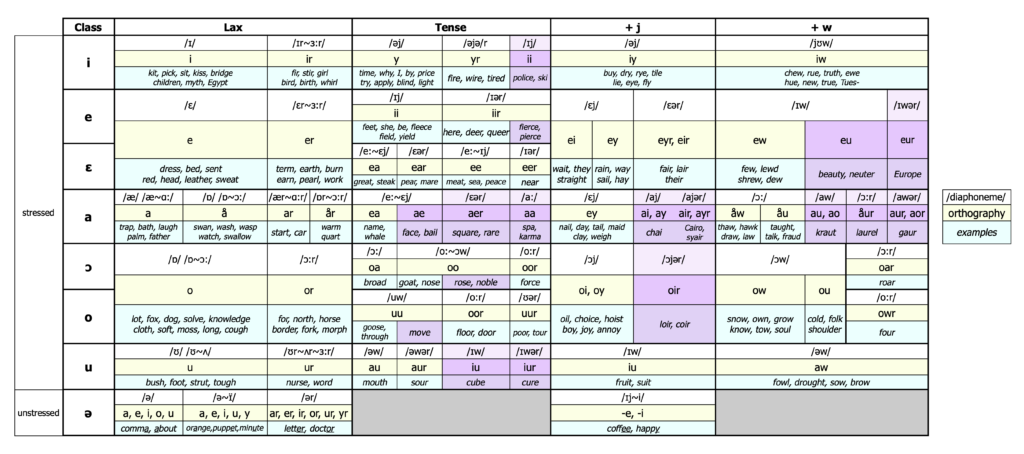
Another criterion of mine, bold perhaps, was that I’d make every effort to keep vowel digraphs recognizable and therefore also make a distinction between words’ origins as native English, North Germanic, Latinate/French, or as a foreign borrowing. Having a few extra orthographic standards available for use with these origins further reduces the number of homographs, stays true to etymology, and occasionally aids in maintaining word recognizability. For example, right–write–rite become ryht–wryt–ryt and merry–marry–Mary become meri–mari–Maeri. The vowel in great/pear or broad/roar remains for these words which “lagged behind,” as the others with EA or OA continued to evolve by raising, while words like head or goat require respelling with the new classes they entered long ago: hed (which shortened), goot (which raised as normal).
For consonants, most didn’t need much fixing, but I made a few clarifications. For /k/, all three spellings of C, K, and Q were maintained depending on etymology: C for native English or Latinate words, K for words of Nordic or foreign origin, and Q for either Latin or foreign (e.g. Semitic) origin. Thus: cat, thic, cing/cwiin, skin, kik, iuniiq, quårt, Qairo. Meanwhile, all instances of soft G receive a diacritic dot to be written with Ġ, whether native English or French, whether /dʒ/ or the arguably phonemic /ʒ/: briġ, ġygantic, ġenre. Soft C, as Ç, remains only if of Romance origin and etymologically justified: face as faeç but fierce as fiirs. Leading naturally from this, native English ⟨ch⟩ /tʃ/ in church contrasts with French-loaned ⟨çh⟩ /ʃ/ in brooçhuur.
There are various other consonantal considerations not gone into detail here but which appear in the poster, such as yod-dropping and yod-coalescence, or silent K remaining as H (hnoleġabl, hnot) to avoid disorientation and in the continued spirit of avoiding homographs. Feel free to get in touch with me to ask about my reasoning or to discuss further.
The research demonstrates that the reformed English spelling system as devised here, while remaining somewhat complex, would be much more consistent and predictable than the traditional spelling we use now; however, while the benefits are clear, widespread adoption would face the significant social challenges of the process of starting afresh with an updated system: lots and lots of education, enforcement, and spending. Given the potential disruption, keeping the traditional system despite its flaws and complexity may be the most practical solution.
References:
- Brooks, Greg. “8. The graphemes of written English.” Dictionary of the British English Spelling System (2015): 253-266.
- Mazarin, André. “The developmental progression of English vowel systems, 1500–1800: Evidence from grammarians.” Ampersand 7 (2020): 100058.
- Minkova, Donka. A Historical Phonology of English. Edinburgh University Press, 2013.
- Nicolai, Garrett, and Grzegorz Kondrak. “English orthography is not “close to optimal”.” In Proceedings of the 2015 Conference of the North American Chapter of the Association for Computational Linguistics: Human Language Technologies, pp. 537-545. 2015.
- Sándi, Gábor. “The phonology of the dialects of England.” PhD diss., University of British Columbia, 1976.
- Schendl, Herbert, and Nikolaus Ritt. “Of vowel shifts great, small, long and short.” Language Sciences 24, no. 3-4 (2002): 409-421.
- Veatch, Thomas Clark. English vowels: Their surface phonology and phonetic implementation in vernacular dialects. University of Pennsylvania, 1991.