
Another lovely blog ready for you! This post will essentially be a review of a DH project I’ve taken a look at and explored recently: Coptic SCRIPTORIUM (Sahidic Corpus Research: Internet Platform for Interdisciplinary multilayer Methods). First up, what’s Coptic? Um, it’s a language, you fool! Follow me this way.
Language families are a thing, and in this house, we love them. One of the world’s primary language families is the Afro-Asiatic group which boasts over half a billion speakers. Some of its major subdivisions (and languages) include Semitic (Arabic, Hebrew, Amharic, Phoenician…); Cushitic (Somali, Oromo); Chadic (Hausa); Berber/Tamazight; Omotic; and today’s star of the show, Egyptian. But Tim—you rudely interject—didn’t you say Coptic was the focus? Yes, languages evolve, and so can names, unless you insist that you’re currently reading Ænglisċ. Grossman and Richter frame the situation well: “The Egyptian-Coptic language is attested in a vast corpus of written texts that almost uninterruptedly document its lifetime over more than 4,000 years, from the invention of the hieroglyphic writing system in the late 4th millennium BCE, up to the 14th century CE. Egyptian is thus likely to be the longest-attested human language known.” A casual four-thousand-year history and then it just… went extinct? So are today’s Egyptians not the same or descended from the ancient ones, then? Well, yes and no, though don’t tell the Copts I equivocated. At least one in ten Egyptians are Copts (you’re welcome for the etymological connection), most of whom are Orthodox Christians, with a small Catholic minority within that minority; as Islam spread and Egypt was culturally Arabized, the incoming language also dominated, and Coptic—which had been the linguistic continuation of ancient Egyptian—was supplanted by (but not before influencing) Arabic. Today, Coptic continues as the liturgical language of the Copts, and there’s plenty of literature for us to sink our teeth into, including many early Christian manuscripts.
Enter the SCRIPTORIUM: I’m not shouting, that’s just an acronym. See above. Caroline Schroeder (University of Oklahoma) and Amir Zeldes (Georgetown University) are its creators and seem to be an ideal match coming from different specializations: Schroeder from religious studies and history, and Zeldes from computational linguistics and programming. Their project, launched in 2014, boasts a formidable collection of well-digitized corpora written in Coptic aiming to advance knowledge in fields like linguistics, biblical studies, and history by increasing access to such significant texts as these.
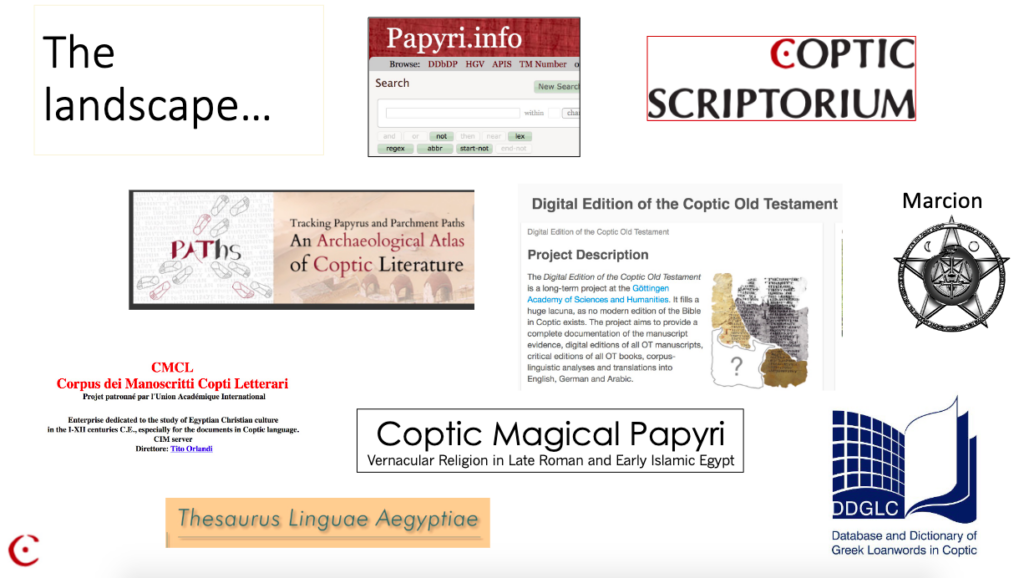
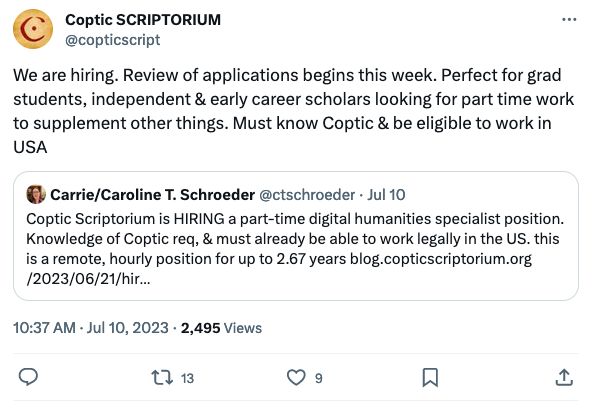
One thing immediately evident upon exploring this project is that it is part of a greater constellation of resources. One of these, the Coptic Dictionary Online whose search interface Zeldes co-designed, was also the 2019 winner of Best DH Tool at the Digital Humanities Awards—yes, those exist! In addition to the SCRIPTORIUM working closely with various other organizations and projects, it also maintains a presence on GitHub, X~Twitter, and Schroeder’s YouTube channel. Audience is key, and I also found several instances of outreach to collaborate with teachers, whether through postings or when mentioned during a pretty en-lightning talk (get it??) given by Schroeder to the North American Patristics Society in 2021. Another important consideration for DH projects is their sustainability and applicability, and for these I have no critiques. It seems to me that room for further growth continues, as there is clearly an enthusiastic [Digital] Coptic Studies field out there. A cursory glance at the various conference recordings they’ve uploaded to YouTube shows that the field enjoys institutional backing: it certainly doesn’t hurt to have the NEH’s Office of Digital Humanities and Division of Preservation and Access financially supporting your work, not to mention the German federal government’s Ministry of Education and Research! These grants are what allow the work to continue, and as recently as this July they proudly advertised that they are hiring:
To follow up on how Coptic SCRIPTORIUM considers its audience, I was impressed (as of September 2023 when I am reviewing this project) with the FAQs they’ve crafted for all the documentation entailed in the project. Some aspects of what the site is capable of can be rather overwhelming, but it’s clear to me that effort’s been put into making this immense amount of data accessible to people who may not know the difference between a “diplomatic” vs. “normalized edition” of a manuscript or who the heck Shenoute was. Later video tutorials on Schroeder’s YouTube channel, the successors to a delightful introductory video to the project in 2014, also help orient any visitors to the site and contextualize the use of the many tools offered.
Speaking of, let’s indulge more closely in some of the site’s offerings now that I’ve kept you waiting, shall we? Coming to this project as someone in Romance philology who’s a little spoiled by the sheer volume of resources available in Late Latin and early Romance, at first I was thinking, “Okay, so this list of corpora is not exactly short, but it’s also not that impressive, is it?” That was, frankly, before I checked myself. After looking around more carefully at the well-curated materials and seeing the depth of their metadata—I mean, we’re talking tagged word forms, parts of speech, lemmas, syntax, translations, the lines/columns/pages of the original manuscript—so much is searchable! Even the Greek-derived vocabulary will link out to Perseus, a humanities database I know well from my use of its digitized Latin dictionary. I love that you can consult whether a particular piece of metadata in the SCRIPTORIUM has been checked by a human expert, rather than lying there dormant after an NLP error gone unnoticed. The people running the project seem particularly jazzed about recent developments in entity recognition which they’ve applied to their corpora and there’s a neat interactive visualizations page all about it.
What else, what else… the site worked fine on my smartphone and they have a customized-for-Coptic ANNIS search and visualization architecture with a Coptic keyboard for more easily typing input into the search. I saw it mentioned in one video tutorial that Chrome and Safari, but not Firefox, were supported for the analytic view of something, but as of writing this I’ve used Firefox the whole time and seen no issues for my browser. Aside from that, and I’m not sure if this is more a critique of myself or the project, but as insinuated earlier it’s occasionally an information- or possibility-overload to navigate through all the technical processes at play. There are perhaps too many “nooks and crannies” of the site, like one page where I found an excited description of a new grant, “set to run from fall 2018 for three years.” The video tutorials are all well and good, too, as are the screenshots of their search tools, but maybe newcomers like me could benefit from a more conceptual page dedicated not so much to written explanation of the project’s potential, but rather to more visual representations highlighting some of the work that’s already been done without simply linking to videos of presentations.
Accessibility is so often half the battle, and we have here a goldmine for the scholars, digital or otherwise, who want to peruse the documents the creators have compiled and marked up. The creators sought to develop “a digitized corpus of Coptic texts available in multiple formats and visualizations” as well as a list of several specific computational tools for analysis, visualization, and the like. Their database and tools (like the ANNIS search and visualization infrastructure) have most certainly achieved these with flying colors; ten out of ten! As for their additional goal of creating “a collaborative platform for scholars” to contribute, conduct research, and so on, I hesitate to nitpick here because clearly, that’s happened. Still, shouldn’t a self-professed collaborative platform include at least some modest element (a message board?) of social interaction among its users? ANNIS has a login box up in the corner, so for what little I know, there may be some way for more spirited, inspired user communication through the densely-populated-with-data site.
When Schroeder wrote in 2019 how the project addresses a need for “an open access digital environment for the study of the language and literature of Roman and Byzantine Egypt,” I wonder if she knew then just how much more successful she and Zeldes would become: year after year, the NEH has granted them more funding to continue their work, which is certainly another way of measuring success. With the rather more implicit goal of bringing Coptic closer to the level that Greek and Latin are at online, there’s plenty of ground to cover, but Coptic SCRIPTORIUM is chugging away nobly towards that end.
Schroeder, Caroline T., Amir Zeldes, et al., Coptic SCRIPTORIUM. 2013-2023. https://copticscriptorium.org